

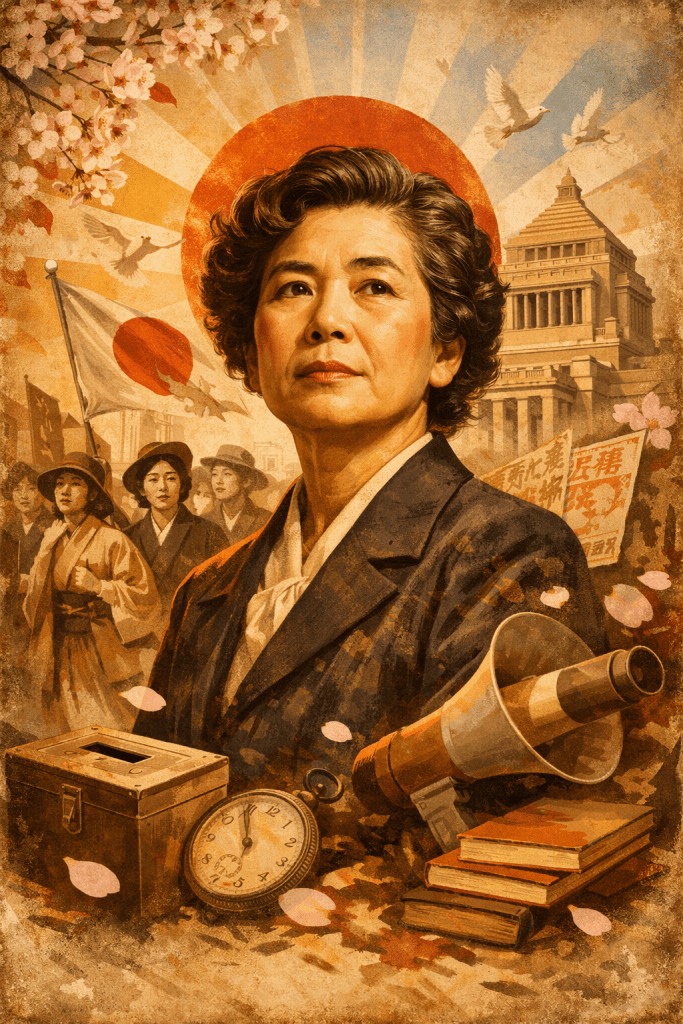
**Japanese Women Who Spoke Up 🌸
Fusae Ichikawa**
There are women who speak loudly—and then there are women who refuse to be erased.
Fusae Ichikawa was the latter.
She didn’t rise in a time that welcomed women’s voices. She rose in a time that actively tried to silence them. In early 20th-century Japan, women were barred from political participation altogether. They couldn’t vote. They couldn’t join political organizations. They were expected to stay quiet, stay domestic, and stay out of public life.
Fusae Ichikawa said no.
And she didn’t say it once.
She said it over decades.
She organized women when it was dangerous to do so. She challenged laws that treated women as dependents rather than citizens. She believed—steadfastly—that democracy without women wasn’t democracy at all. And when Japan finally granted women the right to vote after World War II, she didn’t step aside and let others take credit.
She stepped in.
Fusae Ichikawa ran for office. She served in the Japanese Diet. And she continued advocating for women’s rights, clean politics, and ethical governance well into her later years.
Let that sit for a moment.
This wasn’t a young woman’s rebellion that faded with time.
This was a seasoned woman’s lifelong commitment.
What speaks to me most about Fusae Ichikawa isn’t just that she helped change laws—it’s that she understood something many still struggle to accept today: change takes endurance. Speaking up isn’t a moment. It’s a practice.
She didn’t chase applause.
She didn’t rely on trends.
She didn’t stop once progress was made.
She stayed.
As I move through my own season of aging, reflection, and clarity, her story hits differently. There is power in women who continue to show up after the headlines fade. There is authority in lived experience. There is wisdom in women who understand that systems don’t shift overnight—and that sometimes the work of speaking up is quiet, strategic, and relentless.
Fusae Ichikawa reminds us that elder voices matter. That women do not age out of relevance. That courage doesn’t belong to the young alone.
She spoke up when it cost her something.
She stayed engaged when others would have stepped back.
She left a legacy that still echoes.
And that—right there—is the kind of voice worth remembering.
 Lady Flava News