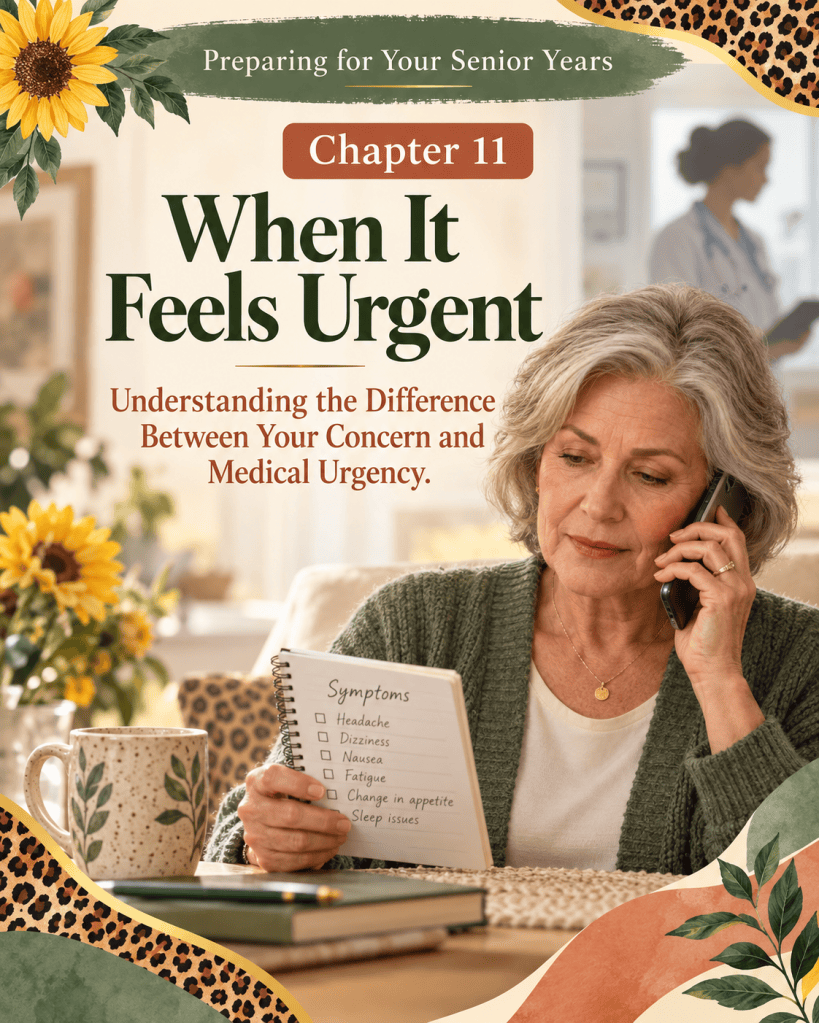
Preparing for Your Senior Years
The Conversations We Should Be Having in Our 50s
Chapter 11
When It Feels Urgent: Understanding the Difference Between Your Concern and Medical Urgency
Dear Friends,
Every day, I speak with patients who are in pain and anxious about their health. Many describe their situation as urgent. When you’re the one living with pain, losing mobility, frightened by new symptoms, or unable to live your normal life, it can feel urgent because you need help and answers.
Most of all, you want someone to understand that you cannot continue living this way.
Healthcare is very different today. In my opinion, our healthcare system is carrying a tremendous amount of demand, and many teams are working hard to keep up. Federal projections from the Health Resources and Services Administration estimate shortages in 30 of the 35 physician specialties they modeled by 2038.
Think about the COVID-19 pandemic. Hospitals faced enormous pressure. The CDC documented staffing and supply shortages, along with the strain those shortages placed on hospitals.
I worked at a rehabilitation hospital in Las Vegas that took in COVID patients. I watched people die and then be taken out in black body bags. I watched families sit outside in lawn chairs, trying to remain as close as possible to the people they loved because they could not be inside with them.
Hard decisions had to be made during that medical crisis. Healthcare workers were pushed beyond what anyone thought they could handle. They had to determine who needed immediate care while working with limited staff, space, and supplies.
That was a medical emergency in every sense of the word.
Now, let me bring this conversation back to today.
I work with specialty surgeons. Many people may not realize that surgeons are not sitting in clinic five days a week waiting for appointments. Some may spend part of the week seeing patients and the rest performing surgery. Operating room time also has to be scheduled across surgical teams.
So, how does a specialty clinic determine whose medical condition needs attention first?
That can be a very hard call.
Clinicians consider a patient’s symptoms, physical examination, medical history, vital signs, laboratory results, imaging, and whether the condition is rapidly worsening or creating an immediate risk of harm.
Imaging is important, but it does not always explain the full severity or source of a person’s pain. One person may have significant changes on a scan and manageable symptoms. Another may be struggling terribly even when the imaging does not look as severe as expected.
That does not mean the person’s pain is not real. It means the clinical team has to put all the pieces together.
What Do Medical Clinics Do?
Medical clinics triage. They determine which patients have emergency warning signs, which need an expedited appointment, and which can safely wait for the next available opening.
Triage is not a measure of whose suffering matters most. It is an effort to identify who may be at the greatest immediate medical risk.
The person in terrible pain may feel forgotten while someone with less pain—but a medically dangerous condition—is moved ahead. That is difficult to accept when you are the one waiting.
And even when a concern is not classified as an emergency, the patient still deserves communication: an acknowledgment, an explanation of what happens next, and a safe plan for what to do while waiting.
What Can Patients Do?
If your condition feels urgent but has not been classified as medically urgent:
- Clearly explain what has changed since your last evaluation.
- Describe what you can no longer do—not only how much it hurts.
- Report new weakness, falls, loss of function, or rapidly worsening symptoms.
- Ask when you should expect a response or callback.
- Ask which warning signs should lead you to urgent care or the emergency department.
- Complete requested labs, tests, and imaging as soon as possible.
- Schedule the follow-up appointment needed to review those results.
- Ask to be placed on the cancellation list.
- Keep a short record of your symptoms, dates, and changes in what you can do.
- Ask what you can safely do while you wait.
- Continue following up respectfully when your condition changes.
The word “urgent” tells the clinic how concerned you feel. Clear details can help the team understand what has changed and decide whether your situation needs to be reassessed.
Instead of saying only, “My condition is urgent,” try explaining:
- “Since my last appointment, I now need support to walk.”
- “I have developed new weakness.”
- “My symptoms are getting worse quickly.”
- “I can no longer manage the stairs in my home safely.”
- “My ability to function has changed significantly.”
Those details help paint a clearer medical picture.
If you have signs of a possible medical emergency—such as difficulty breathing, chest pain, sudden confusion, sudden weakness, or loss of consciousness—call 911 or seek emergency care. For other new or worsening symptoms, contact a medical professional promptly for guidance.
Patients deserve compassion, communication, and a clear understanding of what happens next. Medical teams also carry the responsibility of making decisions amid limited appointments, operating room time, and more patients asking for help than the system can immediately accommodate.
Both realities can be true:
Your pain is real.
Your fear is real.
Your need for help is real.
And your condition may still not meet the medical criteria for emergency or expedited treatment. That does not mean you should be left without a response or a safe plan.
So, what do you do?
You remain informed.
You report meaningful changes.
You ask direct questions.
You complete the testing needed to move your care forward.
You learn the warning signs that require emergency care.
And you continue advocating for yourself—clearly, respectfully, and consistently.
Because not being classified as medically urgent does not mean that you do not matter. It means the next step needs to be clear.
What Can You Control While You Wait?
While you are waiting for a much-needed medical appointment, there may still be parts of your health you can care for.
Ask yourself:
- Do I need to drink more water, if I have not been placed on a fluid restriction?
- Do I need more rest?
- Do I need to pay closer attention to what I consume?
- Is there safe movement that fits my condition and my clinician’s guidance?
- Would it help me to relax, breathe, pray, or meditate?
These choices do not replace medical evaluation or treatment. They are ways to care for your mind and body while you wait for the next step.
Remain aware.
Remain involved.
Do what you safely can.
Your health starts with you.
Let’s talk about it.
Have you ever felt that your medical situation was urgent, but the healthcare system did not respond with the same sense of urgency? What did you do while you waited?
Lady Flava Wellness 🌻