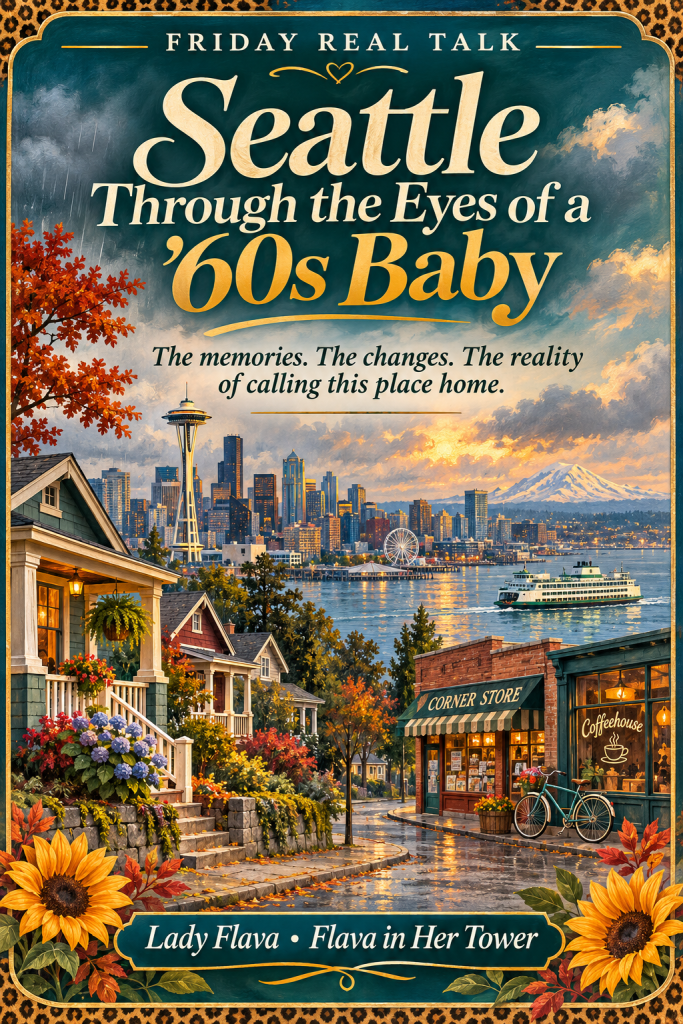
Friday Real Talk: Seattle Through the Eyes of a ’60s Baby
The memories, the changes, and the reality of calling this place home.
The other day, I Googled the pros and cons of living in Seattle. I was trying to find a different angle to write about my hometown.
Well, there was plenty to read. The economy, the weather, the cost of living, the arts, the outdoors, and that thing people call the “Seattle Freeze.”
It was too much to go through. 🤣
But it got me thinking about the Seattle I know. The one I grew up in, went out in, raised a family in, and built something of my own in.
I’m a ’60s baby. I remember when neighborhoods were neighborhoods.
You knew your neighbors. We had mom-and-pop corner stores. We walked, rode bikes, and caught buses to get where we wanted to go—with parental permission, of course. We weren’t just heading out wherever we pleased. 😉
So much of the time, I think about those days with a smile. The familiar faces, the places we gathered, and the feeling of knowing where you belonged.
My foundation was growing up as a Japanese German girl in the Black community of Seattle’s Central Area. That community is part of who I am.
As a young adult, girl, I went dancing.
Ladies’ nights, Fridays, Saturdays. Downtown, Columbia City, the South End, Burien, or around Seattle Center. Where we ended up depended on who was hyping up which venue and where we thought the music and crowd would be good.
And no, we didn’t let the rain stop us.
We lived in Seattle. If we waited for perfect weather, we would have missed a whole lot of life.
Over time, my circle became smaller and more settled. Weekends shifted toward family things. Life changed, and so did how I experienced my city.
Then our neighborhoods began changing in ways that went much deeper than my own growing older.
Gentrification shifted the Central Area.
It is sad to look at places that hold your memories and barely recognize them. To see familiar businesses disappear and people priced out of communities they helped build.
I hear words like “improvements” and “upgrades,” and I have to ask: Who benefited?
Because when the people who gave a neighborhood its identity can no longer afford to live there, I struggle with calling that progress.
Those were people’s homes. Their relationships. Their history.
My memories and foundation were there.
Eventually, I built a coffee house in North Seattle: Flava Coffee House.
I wanted a welcoming space for the diversity of that community. Somewhere people could feel comfortable, connect, and bring their creativity through the door.
We had independent books, artwork on the walls, and Friday-night open mics supported by the creative community. I wanted creatives to have a haven, and I wanted people to experience talent they might otherwise never encounter.
Keeping the doors open was another story.
Competition from Starbucks, the economy, and my own limits in business knowledge all played a part. I can be honest about that. I had the heart and the vision, but I wasn’t business savvy enough to keep it going for another five years.
Flava Coffee House existed from 2003 to 2008. And although the doors closed, what began there continued.
The Flava opened the door to creative soulz near and far.
I became heavily involved in Seattle’s hip-hop community. The diversity fascinated me—the different sounds, interpretations, stories, and ways people expressed themselves.
That was also when I saw up close how much underground independent artists struggled.
There was plenty of talent. The challenge was connecting that talent with the right opportunities to perform, build an audience, and make money.
Having a gift and getting paid for it are two different challenges.
I don’t believe Seattle has ever lacked creative people or things to experience. But then and now, finding your way into those spaces often comes down to who you know, who you follow, and what catches your interest enough to get you out the door.
There are jam sessions, glassblowing demonstrations, books and wine, live music across genres, museums, theater, and neighborhood events. Experiences range from free admission to a splurge you plan and save for.
Someone can say, “There’s nothing to do,” while somebody else has three places they’re trying to get to that same evening.
Sometimes you have to find your people and start paying attention to where they gather.
And let’s talk about sports.
Football, baseball, soccer, hockey, and of course, our WNBA Seattle Storm. We have championship history here, and the Storm alone have brought home four WNBA titles.
We love our sports in the Pacific Northwest.
Look at the excitement around the FIFA World Cup. Seattle hosted six matches in 2026, with celebrations bringing fans together around the city. People who weren’t regular soccer watchers found themselves interested in the energy and experience.
That shared excitement is something I appreciate. People coming together, wearing their team colors, and having something to celebrate.
We also have neighborhoods where you can spend time walking, exploring eateries, and finding a place you want to return to. And yes, the water, mountains, and greenery are part of what I love about being here.
Now, let’s talk about what it costs to stay here.
Oh, my.
Housing, electricity, utilities, gasoline, groceries. Whether you rent or pay a mortgage, keeping everything covered can put real pressure on a household.
And moving outside the city doesn’t automatically make everything affordable.
You can appreciate where you live and still feel stressed when the bills come due. A beautiful view doesn’t pay them.
Parking can be another frustration. Finding a spot, paying for it, and figuring out how far you’ll need to walk all become part of the outing.
We have transportation options, but getting around still takes planning. Where you live, where you’re going, and your mobility all affect how convenient those options are for you.
Then there’s our weather.
I enjoy the rain, fog, and cool air. Those things feel familiar to me. But I understand that long stretches of gray skies can be challenging for someone who isn’t used to them.
And you have to learn about layering.
You may need that extra layer in the morning, take it off when the day warms up, and put it right back on in the evening.
Living here, you learn to work with the weather.
We also have serious struggles that deserve an honest conversation. Homelessness is visible across King County. Crime, gun violence, and public drug use affect people’s sense of safety.
I won’t pretend those concerns don’t exist. And I also remember that behind the word “homelessness” are human beings. We need to be able to talk about community safety and human suffering with care for both.
Seattle is also connected to technology, healthcare, education, and research. Institutions such as the University of Washington, Seattle University, and Seattle Pacific University are part of the educational landscape.
But opportunities existing in a region and people being able to access them are two different things. That matters when we talk about how wonderful a place is to live.
And Seattle’s cultural diversity? It is here.
I sometimes hear people ask, “Where are the so-and-so people?”
Trust me, they’re here. But your experience of a city depends partly on the neighborhoods, businesses, events, and communities you spend time in. Once you find those connections, you begin noticing what you hadn’t seen before.
That’s why a list of pros and cons can only tell you so much.
What matters most to you?
Affordability? Family? Career opportunities? Cultural connection? Entertainment? Weather? Access to care? Feeling that you belong?
Your answers may look different at 25 than they do at 65. Mine certainly have changed over the years.
I can smile about the Seattle I grew up in, grieve what our communities have lost, and appreciate parts of my life here today. All of those feelings belong in my story.
I left. I experienced living somewhere else. And I came home.
Now I’m in my tower, watching the birds, enjoying my coffee, and looking at my hometown through older eyes—with plenty of memories and a few strong opinions. 😉
Seattle has its beauty, its opportunities, and some serious issues to face.
Like anywhere else, you have to be honest about what matters to you, what you can afford, and what helps you feel at home.
Real Talk with Lady Flava 🌻
From Flava in Her Tower 🌻