

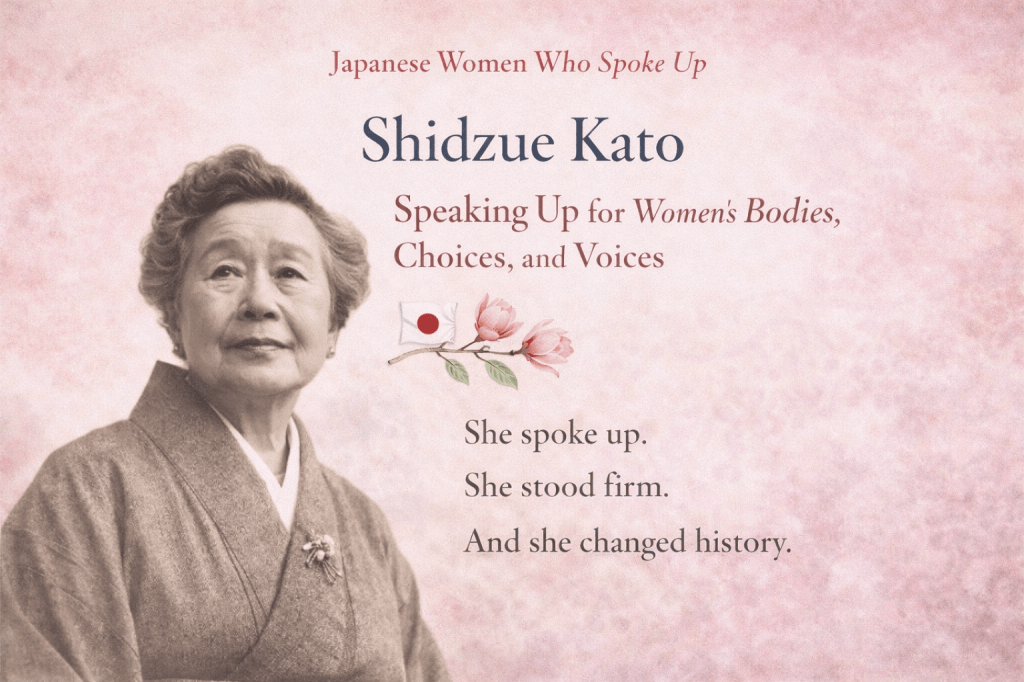
Japanese Women Who Spoke Up: Shidzue Kato
Some women don’t raise their voices to be loud.
They raise them because silence would cost too much.
Shidzue Kato was one of those women.
Born in 1897, at a time when Japanese women were expected to be quiet, obedient, and invisible in public life, Shidzue Kato chose a different path. She didn’t just question the rules placed on women’s bodies and lives—she challenged them openly, at personal and political risk.
Kato believed that women deserved autonomy—over their health, their families, their futures. That belief led her to become one of Japan’s earliest and most outspoken advocates for women’s rights, reproductive freedom, and birth control. Topics that were not just taboo, but dangerous to speak about openly.
And yet—she spoke.
She worked alongside international feminist movements, including time spent in the United States where she was influenced by Margaret Sanger. When she returned to Japan, she brought those ideas home, knowing full well they would not be welcomed easily.
She faced surveillance.
She faced arrest.
She faced public criticism.
Still—she did not retreat.
After World War II, when Japan’s political landscape shifted, Shidzue Kato became one of the first women elected to Japan’s National Diet, where she served for decades. She didn’t soften her message to be palatable. She stayed focused on women’s health, family planning, social welfare, and equality—issues that were often dismissed as “women’s problems,” until people realized they affected entire communities.
What stands out to me most about Shidzue Kato isn’t just her activism—it’s her longevity. She lived to be 104 years old. A century-long witness to change. A reminder that speaking up isn’t always about quick wins—it’s about planting seeds you may never fully see bloom.
She taught us this:
Progress doesn’t come from comfort.
Change doesn’t come from silence.
And women don’t need permission to advocate for their own lives.
Shidzue Kato spoke up—not just for herself—but for generations of women who came after her.
And because she did, the conversation moved forward.

 Lady Flava News