Sunday Real Talk
The Difference Between Graffiti and Street Art
All the years that I was involved in Seattle’s Hip Hop Community, I never really stopped to think about the difference between graffiti and street art.
I’m almost embarrassed to admit that I lumped them together under one umbrella.
I knew there were different styles.
I knew some artists focused on lettering while others created murals.
I knew some pieces felt more personal while others seemed to tell a story.
But I never really thought about why.
Like so many of my blog topics, this started with a video that popped up while I was scrolling.
The creator explained that while graffiti and street art both exist in public spaces, they are actually very different forms of artistic expression.
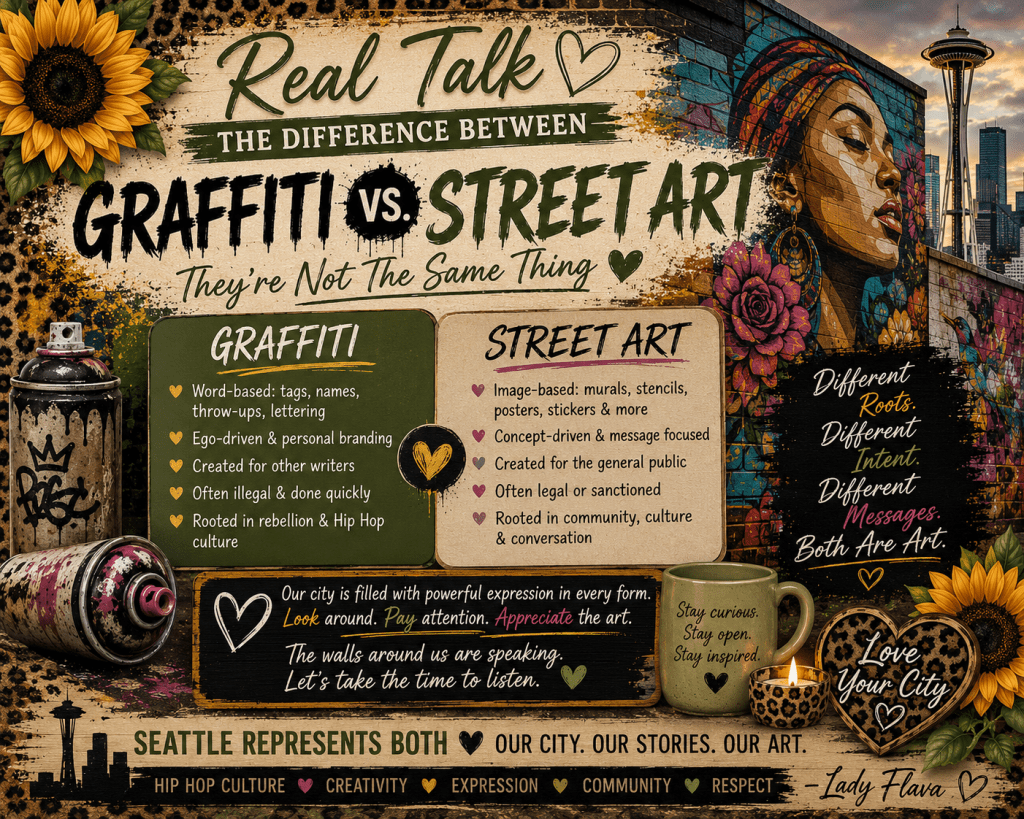
Graffiti
Graffiti is deeply connected to Hip Hop culture and self-expression.
Traditionally, it focuses on stylized lettering, tags, signatures, and names.
For many graffiti artists, the goal is recognition.
It is about developing a unique style and making your mark.
Graffiti has historically existed outside the rules. Because of that, it has often been viewed as rebellious, underground, and sometimes illegal.
Many pieces are created quickly, requiring skill, speed, and creativity.
Street Art
Street art often focuses less on names and more on messages.
It includes murals, stencils, posters, installations, and large public works.
Street artists frequently use images to tell stories, celebrate culture, spark conversation, or highlight social issues.
Many street art projects are commissioned or approved by property owners and community organizations.
The goal is often to engage the public rather than gain recognition from other artists.
Seattle Has Both
One thing I have always appreciated about Seattle is that we have incredible examples of both graffiti and street art.
Our city is filled with murals that celebrate culture, history, music, and community.
At the same time, graffiti continues to be an important artistic voice connected to Hip Hop and urban culture.
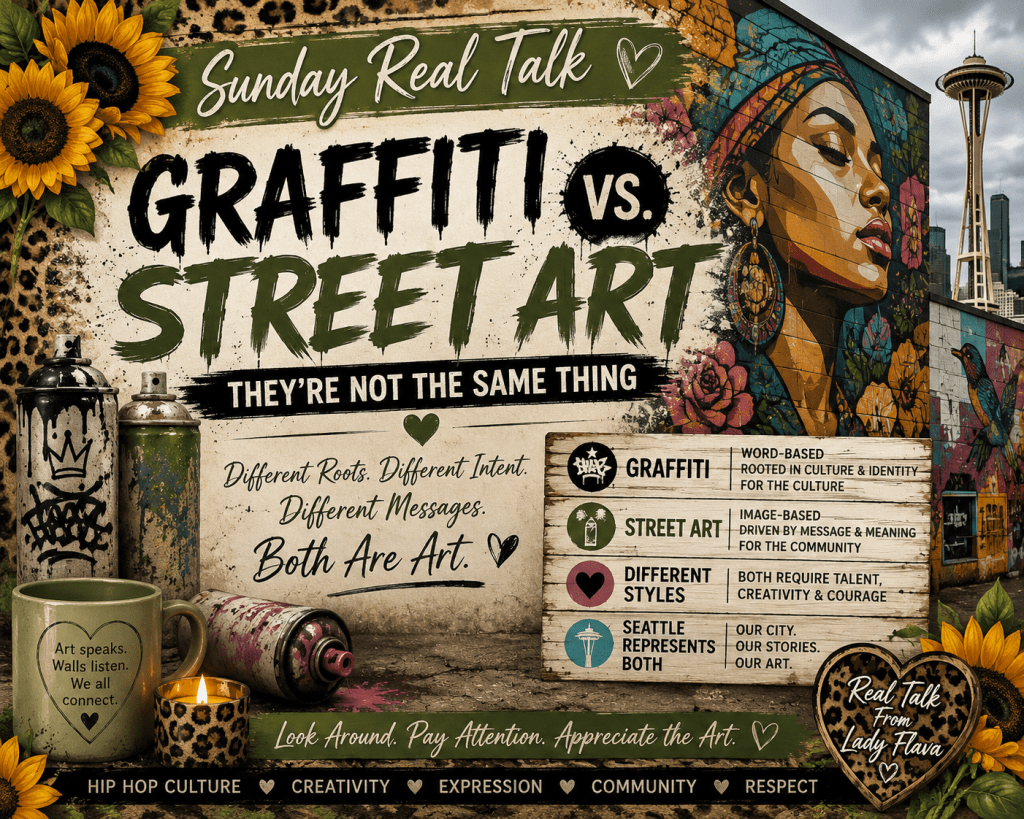
Both forms require talent.
Both require creativity.
Both tell stories.
The difference is often found in the purpose behind the work.
One is frequently focused on the artist’s identity.
The other is often focused on communicating with the broader community.
Final Thoughts
Learning this distinction made me look at public art differently.
What I once viewed as one category now feels like two unique forms of expression.
The next time you walk through Seattle, pay attention.
Look at the murals.
Look at the lettering.
Look at the messages.
Look at the names.
You may discover that the walls around us are speaking in more ways than we realize.
— Lady Flava 🌻