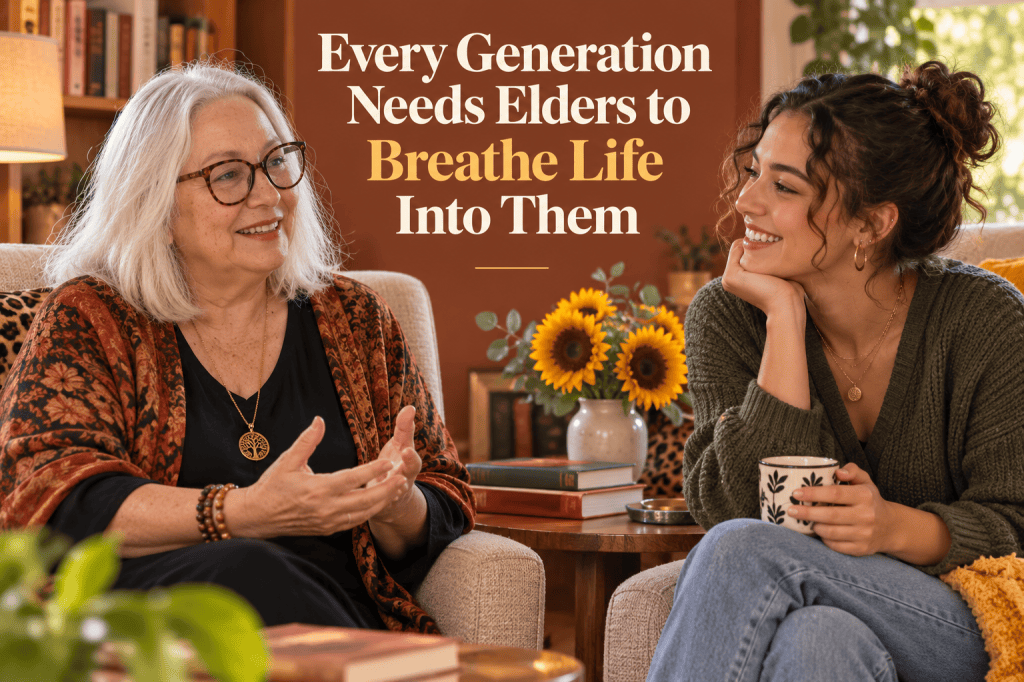
Every Generation Needs Elders to Breathe Life Into Them
When I was coming up, elders were honored and respected.
They were not treated as though they had become irrelevant because they were older. They were recognized as people who had lived through things the younger generations had not yet encountered.
They carried family history.
They understood survival.
They recognized patterns.
They could look at something happening in your life and say, “Let me tell you what I learned when I went through that.”
Elders were expected to breathe life, knowledge and wisdom into the generations coming behind them.
And each generation was expected to reach back.
That was how knowledge continued moving forward.
Today, we have more access to information than any generation before us. We can search for an answer within seconds. We have videos, podcasts, books, online classes and artificial intelligence.
But information and wisdom are not the same thing.
Information can tell you what happened.
Wisdom can help you understand what it cost, what it taught and what you may want to do differently.
An elder can tell you what it feels like to survive disappointment, rebuild after loss, raise a family, leave an unhealthy relationship, change careers, care for aging parents, live through social change or begin again when life does not go according to plan.
That kind of knowledge does not always come with a degree or certificate.
Sometimes it comes with scars.
Research supports the value of bringing generations together. Intergenerational mentoring can strengthen young people’s confidence and belief in their ability to succeed. These relationships can also challenge age-related stereotypes while giving older adults a continued sense of purpose and connection. The Benefits of Intergenerational Wisdom-Sharing
Stanford researchers have also emphasized the important role older adults can play in the lives of young people—especially those who need stability, guidance and someone who will consistently show up for them. Bringing Old and Young Together Benefits Both
But let me be clear.
Being older does not automatically make someone wise.
Some people grow older without ever examining their choices. Some elders repeat harmful patterns, refuse accountability or believe their age means they should never be questioned.
That is not the kind of eldering I am talking about.
A true elder does not use age to control younger people.
A true elder shares wisdom without trying to steal someone else’s journey.
They do not demand that the next generation live exactly as they did. They offer what they have learned and allow younger people to decide what fits the life they are building.
Elders should also be willing to learn.
The younger generations bring knowledge, language, technology, creativity and new ways of seeing the world. Reaching back should never be a one-way relationship.
The elder says, “Let me show you what life taught me.”
The younger person says, “Let me show you how the world is changing.”
Both generations benefit when neither enters the relationship believing they have nothing to learn.
Studies of intergenerational programs have found potential benefits for both younger and older participants, including stronger relationships, improved social skills and more positive attitudes between generations. Evaluation of Intergenerational Activities
So why are we separating generations?
Why are older adults sometimes treated as though our knowledge has expired?
Why are younger people expected to figure everything out among themselves when there are elders who have already survived some of the roads they are approaching?
And why do some elders complain about younger generations without offering them guidance, patience or a safe place to learn?
Every generation needs elders.
Not to dominate them.
Not to criticize everything they do.
Not to keep reminding them that “back in my day” everything was supposedly better.
They need elders who will breathe life into them.
Elders who will recognize their gifts.
Elders who will tell them the truth without humiliating them.
Elders who will say, “You made a mistake, but your life is not over.”
Elders who will teach them how to recover, how to stand up for themselves and how to recognize what truly matters.
Elders who will listen too.
This matters in families, neighborhoods, schools, churches and workplaces.
When elders are pushed aside, families lose pieces of their history. Communities lose perspective. Workplaces lose institutional knowledge. Younger people lose access to wisdom they should not have to wait decades to gain on their own.
If you do not have an elder sharing life wisdom with you, you may be missing an important stage of growth.
And if you are an elder with something valuable to share, someone coming behind you may be missing what only you can give.
You do not have to be related by blood.
Sometimes the elder you need is a neighbor, teacher, coworker, mentor, family friend or community member.
Sometimes we are called to create the relationships life did not automatically give us.
I was raised to believe that each generation reaches back.
Now I understand that we must also reach forward.
Wisdom should not stop with us.
We are supposed to breathe life into the generations coming behind us—and leave them stronger, wiser and more prepared than we found them.
That is part of the responsibility of becoming an elder.
Let’s have a Real Talk Conversation.
Who breathed life and wisdom into you?
And if you are now the elder, whose life are you breathing into?
From Flava in Her Tower 🌻
Real Talk with Lady Flava 🌻