

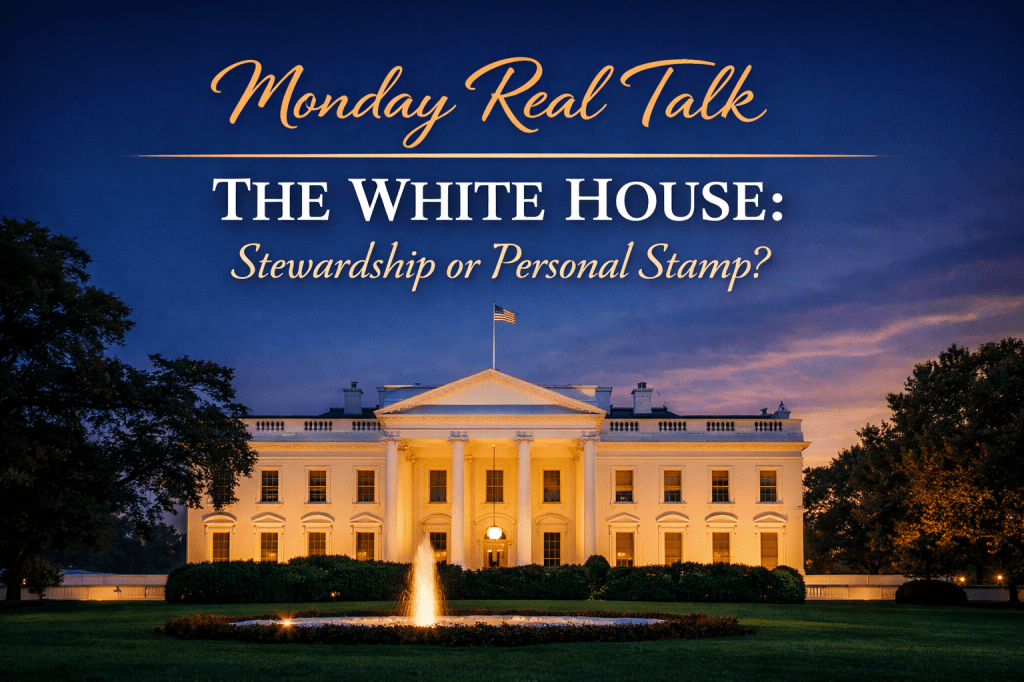
Monday Real Talk
The White House: Stewardship or Personal Stamp?
I’ve been thinking about the White House lately — not as a political stage, but as a symbol.
The White House isn’t just where a president lives and works. It’s a shared home. A place held in trust for the American people. Every president is only a temporary caretaker, passing through a space that carries far more history than any one person ever could.
That’s why the recent changes have been unsettling to watch.
When Donald Trump talks about leaving his “stamp” on the White House, I pause. Because there’s a difference between thoughtful stewardship and personal imprinting.
Demolishing the East Wing to make room for a massive ballroom inspired by Mar-a-Lago.
Paving over the Rose Garden, a space long associated with diplomacy and quiet reflection.
Transforming the Oval Office with heavy gold accents, gilded frames, and personal design flourishes.
Each change on its own might be framed as taste or preference. But together, they begin to feel like something else — a rebranding of a public institution into something more personal, more opulent, more singular.
And that’s where the discomfort lives for me.
The White House has never been about luxury. It has always been about restraint. About continuity. About honoring the office more than the individual who occupies it. Its power comes from what it represents collectively, not from how grand it looks.
What gives me pause isn’t just the design — it’s the private funding. When corporations and individuals help finance changes to the people’s house, questions naturally follow. Not accusations. Questions. About transparency. About influence. About whether a public symbol should ever feel purchasable.
Even the smallest details — curated portraits, selective recognition, golden walkways — carry meaning. Symbols always do. They tell us who belongs, who is remembered, and who gets to define the story.
I keep coming back to this thought:
A leader doesn’t need to overwrite a place to be remembered. History remembers restraint just as much as ambition — sometimes more.
The White House doesn’t need to reflect one man’s taste to be powerful. Its strength has always come from the fact that it belongs to all of us, regardless of who holds the keys at any given moment.
This isn’t outrage.
It’s reflection.
Because when shared symbols start to feel personal, something quiet but important shifts. And it’s worth noticing — calmly, thoughtfully — before we decide that this is just the new normal.
Closing Reflection
Leadership is not proven by how much of yourself you leave behind, but by how carefully you protect what was never yours to take.
An effective leader of the people will ultimately be remembered not for what they built or renamed, but for how they made the people feel.
That’s the part history never forgets.
 Lady Flava News