

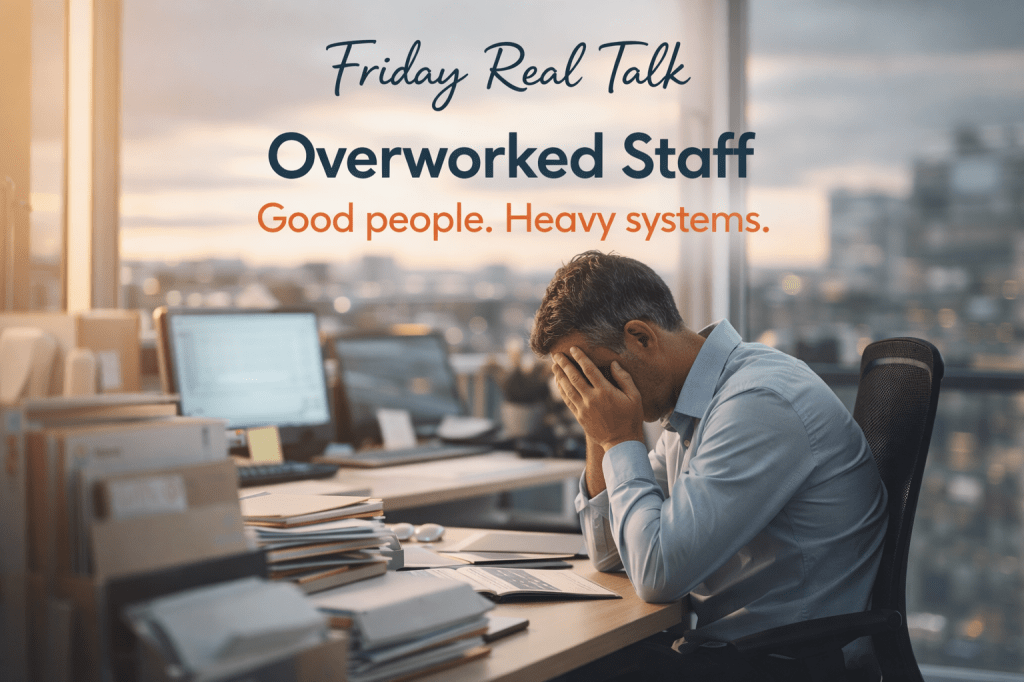
When Workload Grows Faster Than Support
Lately, it feels like many workplaces are carrying more without being given more.
More responsibility — without more staff.
Fewer departments — but the same expectations.
More urgency — with less time to explain, connect, or breathe.
This isn’t about people not caring.
It’s about capacity.
And when capacity is exceeded, the first things to crack are:
communication patience collaboration and customer experience
Not because people want that to happen — but because they’re stretched thin.
What Overwork Actually Looks Like (Beyond “Busy”)
Overworked staff don’t always look dramatic. Often, it shows up quietly:
Shorter responses instead of clear explanations
Assumptions replacing communication
Tasks pushed downstream to whoever “knows how”
Breaks rushed, skipped, or stressed
Frustration leaking into conversations
Coworkers misreading each other’s tone
And customers — patients, clients, families — feel it immediately.
Not because staff are unkind.
But because systems are overloaded.
Why This Is Getting Worse
Across many industries, the same shifts are happening:
departments eliminated or merged
roles expanded without adjustment
busyness treated as productivity
staffing not keeping pace with demand
When everything is urgent, nothing is prioritized — and people burn out trying to do it all.
What Could Help (Without Blame)
These aren’t magic fixes — just stabilizers.
1. Time-blocking tasks
Set clear windows for:
incoming calls outgoing calls administrative work
Not to rush people — but to reduce constant task-switching.
2. Clear prioritization
When everything feels important, staff are left guessing.
Clear guidance on what comes first reduces stress and mistakes.
3. Simple, direct instructions
Clear direction saves time.
Vague expectations create back-and-forth and frustration.
4. Shared responsibility
When the same people always “pick up the slack,” burnout accelerates.
Workflows should support teams — not rely on quiet over-functioners.
5. Normalize breaks
When people feel guilty for stepping away, the whole system tightens.
Breaks aren’t a luxury — they’re maintenance.
Why This Matters
Because when staff are supported:
communication improves
customers feel heard
coworkers treat each other with more grace
mistakes decrease and morale stabilizes
And when staff aren’t supported, everyone pays — including the people trying the hardest.
A Gentle Truth
Most people want to do good work.
Most people care.
Most people are trying.
But no one can outwork an understaffed system forever.
Acknowledging strain isn’t weakness.
It’s awareness.
And awareness is the first step toward doing better — for everyone.
🌻
This isn’t about pointing fingers.
It’s about noticing patterns before people break.
Because when we take care of the people doing the work, the work takes care of itself.
 Lady Flava News