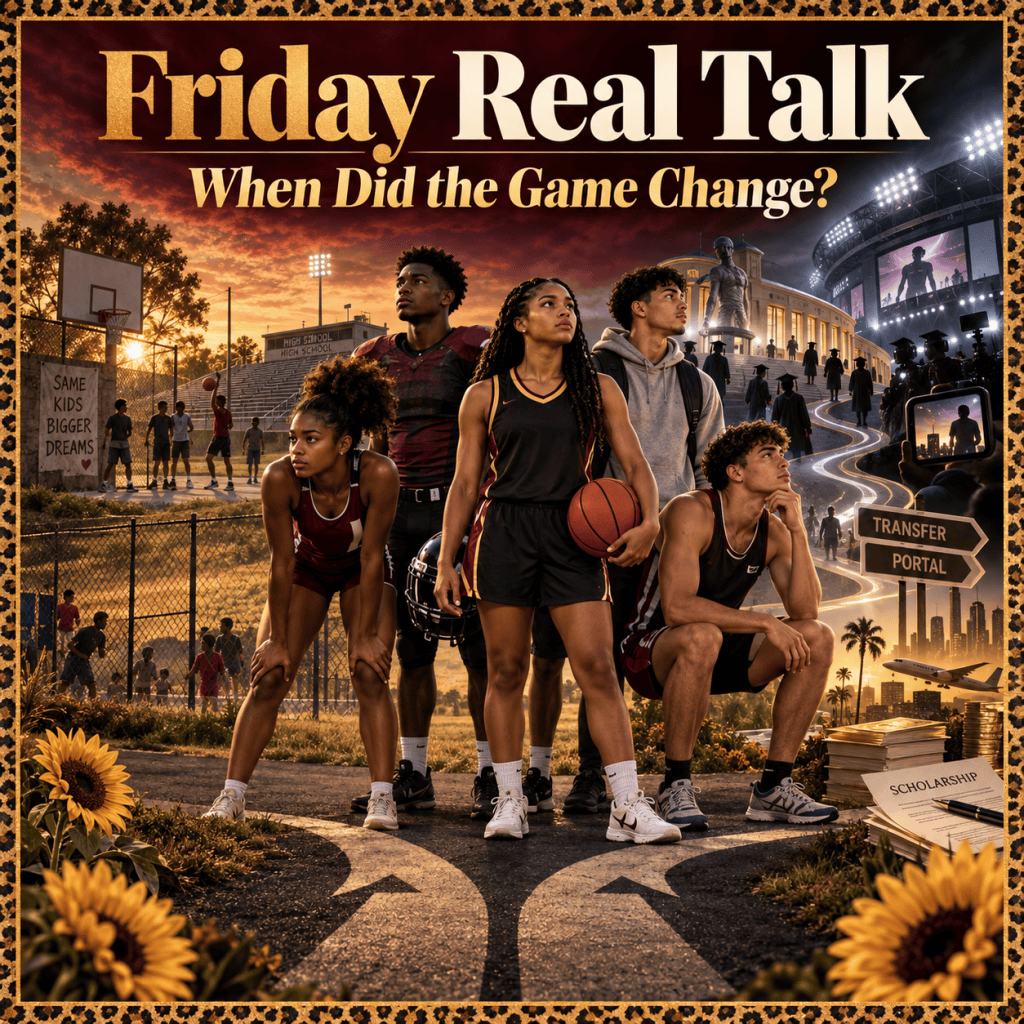
When Did the Game Change?
Friday Real Talk
I grew up watching sports begin in the neighborhood.
There were Pee Wee teams, community centers, playgrounds and local coaches. From there, young athletes moved into junior high, high school and college. A talented few made it all the way to the professional leagues.
I grew up with some of them.
Sports in the 1970s felt competitive, but they also felt community-based and wholesome. Young people learned discipline, teamwork, sportsmanship and how to win—or lose—without losing themselves.
Were those days perfect?
No.
But the path made sense.
A young person discovered a skill. Someone helped develop it. Coaches watched that child grow. Families and neighborhoods cheered them on. The athlete advanced as their ability, maturity and commitment grew.
Today, I look at high-school and collegiate athletics and find myself asking:
When did the game change?
I recently listened to Carmelo Anthony discussing his son Kiyan’s freshman year at Syracuse University on All the Smoke. Carmelo said something that caught my attention: colleges are no longer recruiting high-school athletes the way they once did.
Unless a player is considered one of the very best, that young athlete may be overlooked.
Why?
Because college coaches can now recruit experienced players through the transfer portal. If a coach has a choice between an 18-year-old who needs time to develop and a 21-, 23- or even 25-year-old who has already proven himself at the college level, many will choose the older player.
From a coach’s perspective, I understand it.
Coaches are expected to win—and win now. Their jobs, programs and reputations depend on it. An experienced transfer may be physically stronger, emotionally more mature and ready to contribute immediately.
But what happens to the high-school athlete?
Where does that young person go to develop if colleges only want athletes who are already developed?
The transfer portal was created to give college athletes more control over their futures. A student who is not receiving playing time, does not fit a program or needs a different academic or personal environment should have the freedom to leave.
Name, Image and Likeness opportunities—known as NIL—also corrected something that had been unfair for years. Colleges, television networks and other organizations made tremendous amounts of money connected to athletes, while the athletes were restricted from earning money from their own names and talent.
I believe athletes deserve freedom, choices and fair compensation.
But here is my question:
Did we correct one unfair system while quietly creating another one for the young people coming behind them?
High-school athletes are now competing for college opportunities against experienced transfers. They are being nationally ranked, filmed, evaluated and discussed online while they are still children. Some are expected to build a public brand before they have finished building their own identity.
The game may still be played on a court or field, but business is standing right beside it.
Money is involved.
Social media is involved.
Public opinion is involved.
The transfer portal is involved.
And everyone appears to be searching for the next athlete who can deliver immediately.
What happened to development?
What happened to allowing a talented 18-year-old time to become stronger, learn the college game, make mistakes and mature?
We talk about statistics, rankings, scholarships, NIL value, playing time and professional potential. But underneath all of that is a young person who may have started playing simply because they loved the game.
What happens to that love when their passion becomes everybody else’s business?
There is another layer when the athlete is the child of a professional player.
Carmelo has been present in Kiyan’s development as both a father and someone who understands basketball at the highest level. Deion Sanders coached and supported his son Shedeur through high school and college before Shedeur entered the NFL.
Both sons received opportunities and knowledge that came with having famous fathers. That privilege should be acknowledged honestly.
But access does not take the shots.
A famous name does not complete the pass.
A father’s career cannot perform for his son.
These young men still have to train, compete and prove themselves. Yet people often judge them before giving them time to develop their own identities. Their confidence may be called entitlement. Their opportunities may be dismissed as nepotism. Their mistakes become evidence that they never belonged.
If they succeed, people say their fathers handed it to them.
If they struggle, people say they embarrassed the family name.
That is a tremendous weight to place on a young person.
Today’s young athletes are carrying traditional sports pressure along with expectations that did not exist in the same way when I was growing up. They face online criticism that follows them home. They may worry about a transfer taking their position, an injury lowering their value or one difficult season changing their future.
They are athletes, students, public figures and developing human beings—all at the same time.
And I wonder whether the emotional support surrounding them has grown as quickly as the pressure.
Research has found that suicide has become the second-leading cause of death among NCAA athletes, behind accidents, during the most recent decade studied. That does not mean sports, NIL or the transfer portal directly caused those deaths. Suicide is complicated, personal and rarely connected to one single factor.
But the finding should make every one of us stop.
Are we teaching young athletes how to manage disappointment, conflict and pressure with the same intensity that we teach them how to compete?
Are we checking on their mental health—or only checking their statistics?
Are we asking whether they are okay—or only whether they can play?
Sports can still provide discipline, belonging, education, purpose and joy. They can still change the direction of a young person’s life.
But something has shifted.
I remember watching the athlete grow through the game.
Now, I am watching the business of the game grow around—and sometimes over—the young athlete.
I am not asking to return to the 1970s. The world has changed, and some of those changes were necessary.
I am asking us to slow down long enough to examine what we have created.
If college athletics is becoming a professional-style marketplace, who is responsible for developing the high-school athlete?
If everyone is focused on winning now, who is protecting the young person’s future?
And while we are building stronger, faster and more marketable athletes, who is making sure we are also supporting healthy, grounded and emotionally prepared human beings?
This is bigger than basketball or football.
This is about our children.
While we are developing the athlete, we cannot forget to develop—and protect—the whole young person.
That is today’s Real Talk.
Real Talk with Lady Flava 🌻