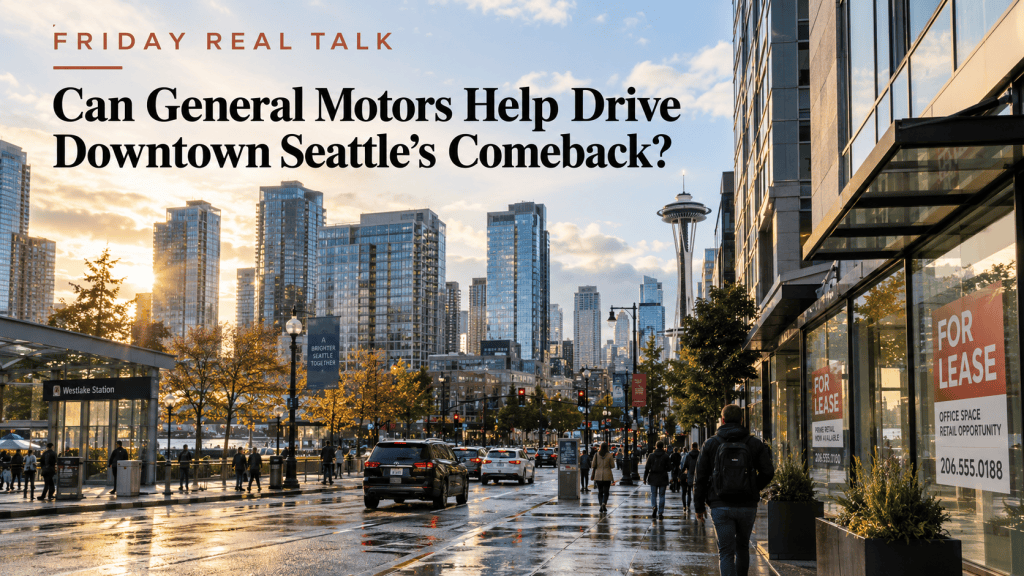
Can General Motors Help Drive Downtown Seattle’s Comeback?
I recently learned that General Motors is opening a new technology office in downtown Seattle.
The company has leased approximately 43,000 square feet inside the West8 building at 2001 Eighth Avenue in the Denny Triangle. The office is expected to open in early 2027.
This is not a car dealership.
The Seattle office will bring together employees working in areas that include digital products, autonomous vehicle technology, information technology, human resources, and marketing. General Motors also plans to recruit additional engineering talent, particularly in artificial intelligence and machine learning.
As someone born and raised in Seattle, I find this exciting.
Watching Downtown Lose Its Energy
Over the past several years, it has been disheartening to watch businesses leave downtown Seattle.
These are beautiful buildings that were once filled with employees, customers, restaurants, shops, and the everyday movement of people going to work. When major tenants leave, the loss extends beyond an empty office.
Coffee shops lose morning customers.
Restaurants lose their lunch crowds.
Small businesses lose foot traffic.
Transit ridership changes.
The entire neighborhood feels the absence.
According to recent commercial real-estate reporting, downtown Seattle continues to face a historically high office-vacancy rate. That is why seeing an established company like General Motors invest in downtown Seattle feels significant—even if one lease cannot solve the larger problem.
GM reportedly already employs around 200 remote workers in the Seattle region. The new office will bring many of those employees together while creating room to recruit additional talent.
I am happy to see a company use existing office space rather than allowing another portion of a downtown building to remain empty.
Old Buildings May Need New Purposes
I also like the idea of converting some underused office buildings into apartments.
Not every empty office tower will be suitable for housing. Buildings have different plumbing, window, ventilation, and structural limitations. But when conversion is possible, creating homes is a practical way to bring people back downtown.
The City of Seattle now has an Office-to-Residential Conversion Program intended to turn underused office buildings into housing and help revitalize downtown.
A healthy downtown should not depend only on people arriving for work and leaving at 5:00.
It needs residents.
It needs grocery stores, restaurants, entertainment, healthcare, public spaces, and services people can use throughout the day and evening.
Maybe the future of downtown Seattle is not about rebuilding the exact business district we once knew.
Maybe it is about creating a better mixture of business, housing, tourism, community, and technology.
We Saw What Seattle Could Feel Like
When FIFA came to Seattle, the city felt alive.
There were visitors, jerseys, celebrations, crowded streets, and excitement. People were walking through downtown and enjoying the waterfront, Seattle Center, Pioneer Square, and the stadium district.
The financial results were not equally positive for every business. Some businesses near the busiest areas benefited, while others reported fewer customers because regular patrons avoided the congestion.
Still, the energy was real.
For a moment, we could see what it looks like when people have a reason to come downtown, move through the city, spend time together, and experience Seattle.
Tourism alone cannot sustain downtown year-round—but it reminds us that our city is still capable of coming alive.
Will This Lower the Cost of Living?
I do not know whether bringing back a strong downtown business community would be enough to raise our local economy and lower the cost of living.
Economic growth does not automatically make life affordable.
New technology jobs may bring investment and opportunity, but they can also attract higher earners without helping the people already struggling with housing, groceries, transportation, and everyday expenses.
For Seattle’s comeback to reach ordinary people, growth must include more than corporate leases.
It must include:
- Housing at different income levels
- Support for small and locally owned businesses
- Safe, clean, and welcoming public spaces
- Continue to grow solid public transportation
- Jobs offering sustainable wages
- Services for the people who already live here
- Reasons to visit downtown beyond the traditional workday
We need business investment, but we also need a city people can afford to enjoy.
A Legacy Company Looking Forward
There is something interesting about General Motors—a company founded more than a century ago—coming to Seattle to build part of its technological future.
GM is still making vehicles, but the automobile industry now includes software, artificial intelligence, digital services, and autonomous-driving technology.
A legacy company is entering a new chapter, and it has chosen Seattle as one of the places to help write it.
That feels hopeful.
One company will not restore downtown Seattle by itself. One office lease will not fill every vacant building, rescue every small business, or lower the cost of living.
But it is movement.
It is investment.
It is someone looking at downtown Seattle and still seeing possibility.
And after watching so many businesses leave, I am grateful to see a major company coming in.
Real Talk Conversation
-What do you believe downtown Seattle needs to become strong again?
-Should the city focus on attracting more businesses, converting offices into housing, expanding tourism—or creating a thoughtful mixture of all three?
-Can Seattle build a downtown that works for corporations, residents, small businesses, workers, and visitors?
-Or has the traditional downtown business district permanently changed?
Let’s have a Real Talk conversation.
Sources: GeekWire, The Spokesman-Review/Seattle Times, and the City of Seattle Office-to-Residential Conversion Program.
Real Talk with Lady Flava 🌻