Friday Real Talk
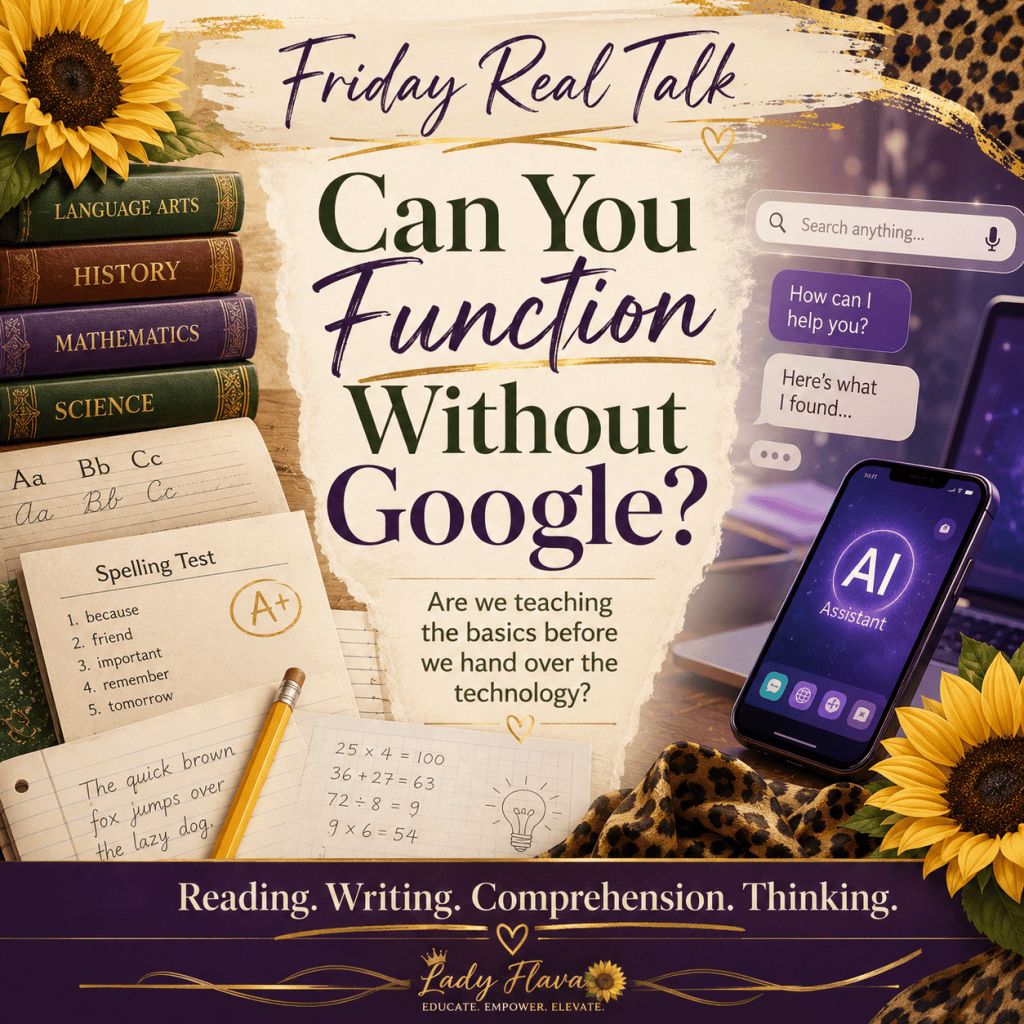
Can You Function Without Google?
I saw a video that really made me think.
It was a teacher on the second day of school working with high school seniors, 17- and 18-year-olds. They were being asked to read a paragraph and fill in four missing words.
Some of them were struggling.
I sat there thinking, How does a student get all the way to senior year and still struggle with something that basic?
Not from a place of judgment.
From a place of curiosity.
Because when I think back to elementary school, our learning looked very different.
We had to write.
We learned print and cursive.
We took spelling tests.
We took math tests.
We went to the library to research.
We checked out books.
If we had a report to write, we had to find the information, read it, understand it, take notes, and then put it into our own words.
There was no microphone to ask Google.
There was no autocorrect fixing every misspelled word.
There was no AI writing the paragraph for us.
There was no video giving us the answer in 30 seconds.
We had to work through it.
And that made me wonder:
Are we giving children technology before we make sure they have the foundational skills to function without it?
Because technology is not the enemy.
I use technology every single day.
Google is useful.
AI is useful.
Spellcheck is useful.
Voice-to-text is useful.
Calculators are useful.
But there is a difference between using a tool after you have learned the skill and using the tool instead of learning the skill.
That is where my concern comes in.
Can a student spell without autocorrect?
Can they write a complete thought without voice-to-text?
Can they read instructions and understand what they are being asked to do?
Can they solve a basic problem without immediately reaching for a calculator?
Can they research something beyond the first answer Google gives them?
Can they sit with a paragraph long enough to understand what it means?
Can they communicate clearly when technology is not doing part of the work for them?
These are not old-fashioned questions.
These are life questions.
Because eventually that teenager becomes an adult.
They may need to understand a lease.
Read medication instructions.
Fill out employment paperwork.
Understand an insurance document.
Read an email from their child’s school.
Follow directions at work.
Compare information before making a financial decision.
And sometimes there will not be somebody standing beside them to explain every word.
Now, I also know better than to judge an entire generation by one classroom.
I have a teenager in my own life who reminds me of that.
E is highly intelligent.
She takes notes.
She keeps separate journals for the stories she writes.
Her vocabulary is probably larger than mine.
And she loves books.
I started reading to her when she was a premature newborn, before she could even sit up. Books became part of her life early, and they stayed there.
So I cannot look at her experience and assume every teenager has had the same one.
And I cannot look at one struggling classroom and assume every teenager is struggling either.
What I can do is ask the bigger question:
Why are children growing up in the same generation having such dramatically different experiences with reading, writing, comprehension, and learning?
Some children grow up surrounded by books.
Some do not.
Some have parents or grandparents reading to them from infancy.
Some do not.
Some have learning differences.
Some have struggled with attendance.
Some lost important classroom time.
Some may have moved from grade to grade without fully mastering the skills from the year before.
And now, layered on top of all of that, we have technology that can make it easier to hide some of those gaps.
You can dictate instead of write.
You can search instead of remember.
You can watch instead of read.
You can ask AI instead of struggling through the answer yourself.
Again, none of those things are automatically bad.
The question is whether we are teaching young people how to think first and use the tool second.
I don’t think we need to go backward.
I don’t think children need to learn exactly the way I did.
The world has changed, and education should change with it.
But some skills are still foundational.
Reading.
Writing.
Comprehension.
Communication.
Basic math.
Problem solving.
Critical thinking.
Those skills should not disappear simply because technology can make life easier.
Maybe the goal is not to keep technology away from children.
Maybe the goal is to make sure technology becomes a support system instead of a replacement system.
Teach them to read.
Then let technology help them research.
Teach them to write.
Then let technology help them edit.
Teach them to think.
Then let AI help them explore another perspective.
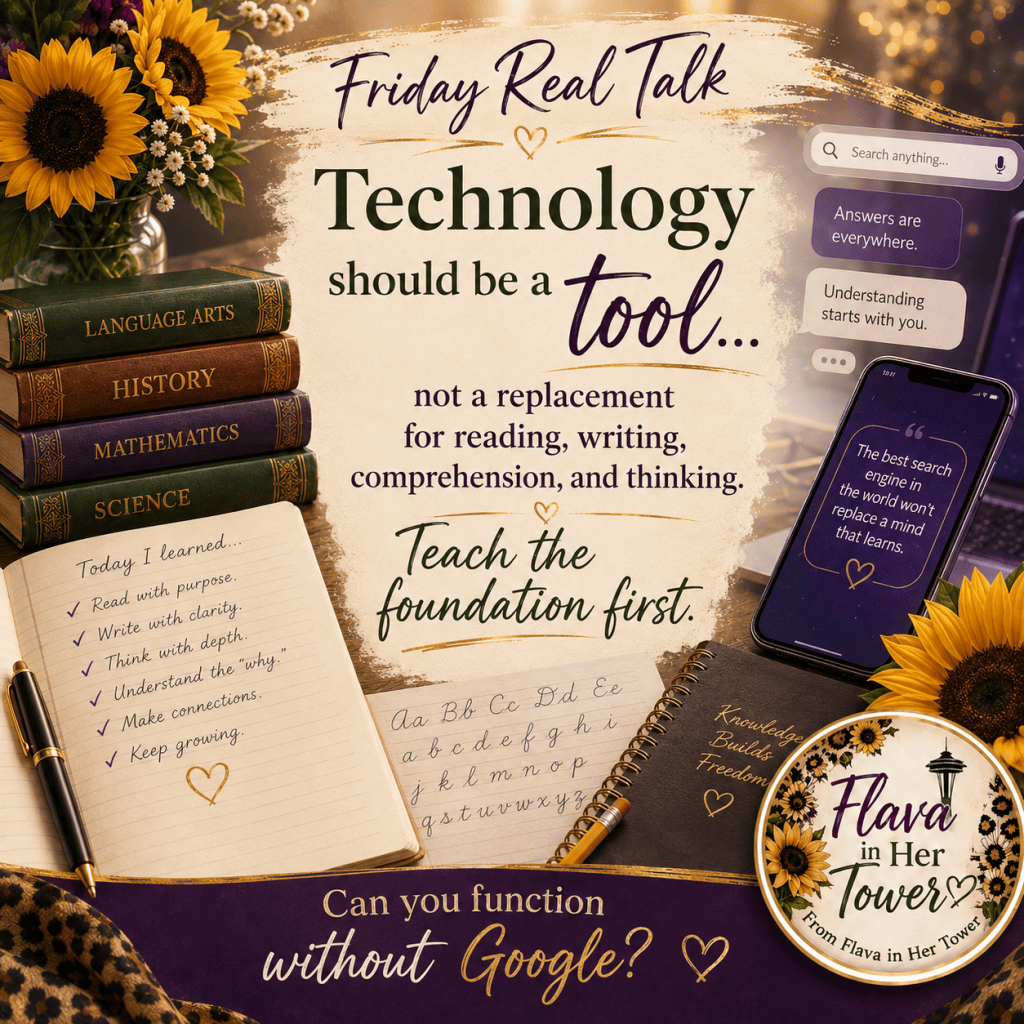
Teach them the foundation first.
Because one day that child will be an adult standing in front of a situation where the answer is not automatically going to appear on a screen.
And when that day comes, I want them to know how to think their way through it.
That is my Real Talk question for today:
Can you function without Google?
And maybe an even bigger one:
Are we making sure our children can?
Real Talk with Lady Flava 🌻