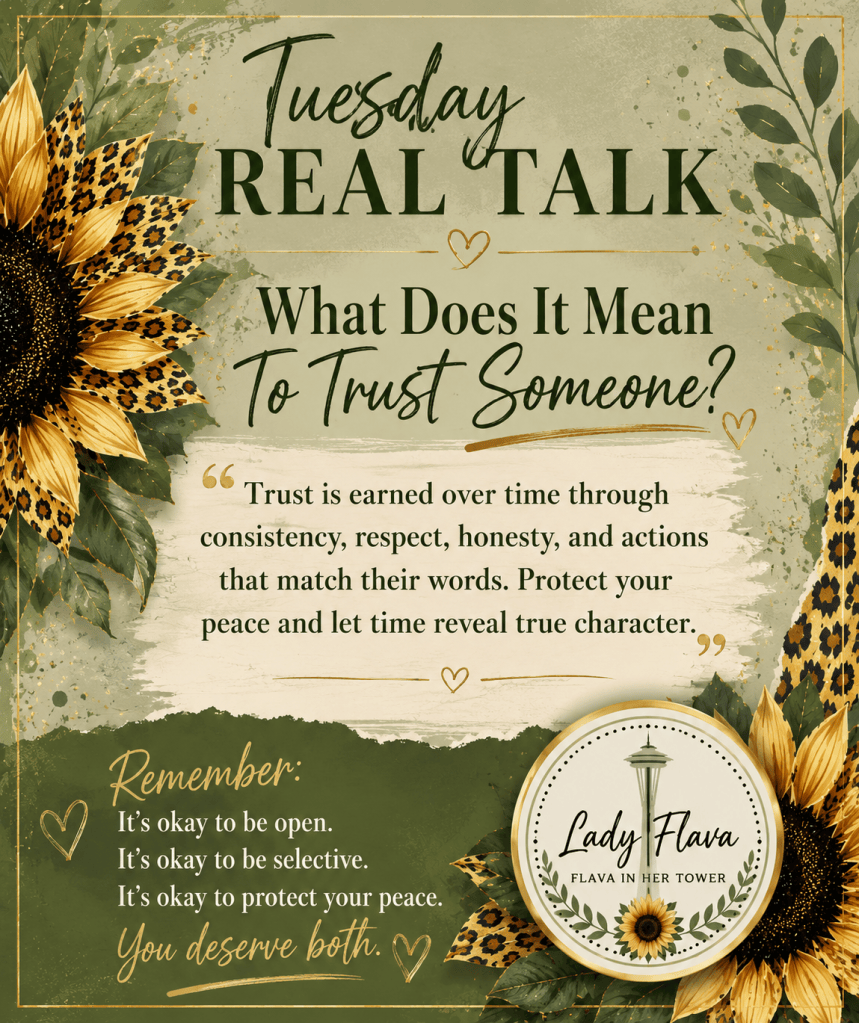
Tuesday Real Talk
What Does It Mean To Trust Someone?
The older I get, the less easily I trust.
That does not mean I think everybody is bad.
It means I have lived enough life to understand that trust should not automatically be handed out just because someone is nice to me, friendly with me, related to me, works with me, or happens to be standing in front of me.
Over the past few years, I have really sat with this question:
What does it mean to trust someone?
And maybe even more importantly:
What do I need from someone before I can trust them?
When I think about trust, I am not talking only about personal relationships.
Trust shows up everywhere.
Family.
Friendships.
Work.
Healthcare.
Customer service.
Retail.
Even being out in public around other people.
There are different levels of trust, and different situations require different things from us.
I may trust someone to help me with a work-related issue and still not trust them with something personal.
I may trust a healthcare provider to treat me medically and still need time before I feel emotionally comfortable with them.
I may enjoy someone’s company and still know that they are not someone I would confide in.
That distinction has become very important to me.
I am open.
I share.
I talk.
But my sharing is selective.
There are very few people I wholeheartedly trust with the deeper parts of myself.
The older I get, the more I realize that being open does not have to mean being completely available to everybody.
There was a time when I gave people the benefit of the doubt much more easily.
I assumed good intentions.
I trusted faster.
I believed that if I treated people well, they would probably treat me well too.
Life taught me that things do not always work that way.
Now I watch.
I listen.
I pay attention.
I notice how people speak about others.
I notice whether their actions match their words.
I notice whether they keep their promises.
I notice how they behave when they are disappointed, corrected, challenged, or told no.
That is where character starts showing itself.
Anyone can appear trustworthy when everything is easy.
What matters is what happens when things are uncomfortable.
Can you admit when you are wrong?
Can you respect a boundary without becoming offended?
Can you hold something private without turning it into gossip?
Can you disagree without becoming cruel?
Can you listen without immediately making everything about yourself?
Can I tell you something vulnerable without worrying that you will throw it back at me later?
Those things matter to me.
I have also realized something else about myself.
If I am going to share something personal or ask for advice, I often prefer talking to someone older who has lived some life.
That does not mean younger people have nothing valuable to offer.
It means that for certain conversations, I want perspective that comes from having been through some things.
I want someone who understands that life is not always black and white.
Someone who has survived disappointment.
Raised children.
Lost people.
Made mistakes.
Recovered from mistakes.
Worked through difficult seasons.
Had to make hard choices.
There is a certain kind of wisdom that comes from living long enough to know that not everything has a quick answer.
That matters to me.
At the same time, age alone does not automatically make someone trustworthy.
I have met older people who are reckless with other people’s business and younger people who are incredibly thoughtful and dependable.
So trust is still about behavior.
Research and psychology around trust often point to some of the same qualities many of us recognize instinctively: consistency, honesty, respect for boundaries, accountability, and emotional safety.
Those things sound simple.
But they are not always easy to find.
Consistency means I do not have to guess which version of you I am going to get.
Respecting boundaries means you do not punish me because I said no.
Accountability means you can own what you did without twisting the story.
Emotional safety means I do not have to regret letting you see a vulnerable part of me.
And honesty means your words and actions line up over time.
That last part matters.
Over time.
Trust is not built in one conversation.
It is built in patterns.
One kind gesture does not make someone trustworthy.
One apology does not automatically repair broken trust.
One promise does not erase repeated behavior.
Trust grows when somebody keeps showing you who they are and what they show you is dependable.
I also believe we need to pay attention to how we feel around people.
Do you feel like you have to constantly explain yourself?
Do you feel guarded?
Do you feel pressured to share more than you want to?
Do you leave conversations feeling exposed?
Do you feel like something you said might become tomorrow’s conversation with somebody else?
Sometimes our instincts notice something before our minds fully understand it.
That does not mean we should become suspicious of everybody.
But it does mean we should pay attention.
There is a difference between being trusting and being naive.
Being trusting means you are willing to believe in people.
Being naive means ignoring what people repeatedly show you because you want the story to be different.
I do not want to become hard.
I do not want to stop believing there are good people in this world.
But I also do not believe everybody deserves immediate access to me.
Trust, for me now, is earned.
Slowly.
Quietly.
Through consistency.
Through respect.
Through actions.
Through time.
And maybe that is one of the gifts of getting older.
You stop feeling guilty for being selective.
You stop explaining why certain people only get certain parts of you.
You understand that protecting your peace does not mean shutting everybody out.
It simply means knowing who has earned the privilege of being let in.
So I will leave you with the same questions I have been asking myself:
What does trust mean to you?
What standards do you use to decide whether someone is trustworthy?
And perhaps the biggest question of all:
Who in your life has truly earned your trust?
Real Talk with Lady Flava 🌻