

Health & Wellness
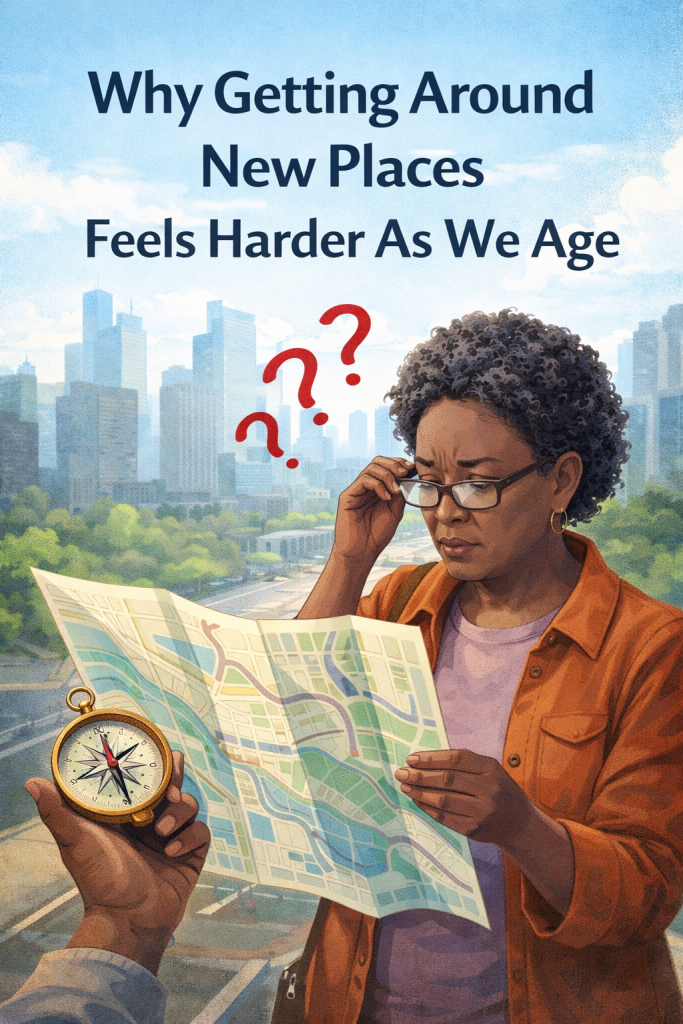
Why Getting Around New Places Feels Harder As We Age
Have you ever noticed this?
You can get to familiar places with no problem —but put you somewhere new, and suddenly your brain feels slower, unsure, even overwhelmed.
You’re not losing your mind.
You’re aging — normally.
And there are real reasons this happens.
🧠 The Aging Brain Works Differently — Not Worse
As we age, the brain becomes more efficient with familiar information and a little slower with new information.
Think of it like this:
Your brain has spent decades building strong highways to places you know well.
New places? Those are side roads still under construction.
That’s not decline — that’s selectivity.
🧭 What Is Spatial Awareness?
Spatial awareness is your brain’s ability to understand where you are in relation to the space around you.
It helps you:
judge distances recognize landmarks understand directions (left, right, near, far) move through spaces without bumping into things mentally map where you are and where you’re going
When spatial awareness is working well, you can picture routes in your head and navigate new places with more ease.
As we age, spatial awareness doesn’t disappear — it simply takes a little longer to process new environments, especially when there’s stress, noise, or visual overload.
🗺️ Why Unfamiliar Places Feel Harder
Finding your way around new places relies on several systems working together:
spatial awareness short-term memory visual processing attention to multiple cues at once
As we age:
the brain processes visual details more slowly distractions compete harder for attention working memory isn’t as quick to “hold” directions
That’s why unfamiliar environments can feel confusing — especially if they’re busy, loud, or rushed.
🚗 Stress Makes It Worse (And New Places Are Stressful)
New places often come with pressure:
traffic signage
GPS instructions
fear of being late or lost
Stress hormones interfere with memory and focus — at any age — but even more so as we get older.
That’s why once you relax or return to familiar ground, clarity usually comes back.
👀 Vision & Sensory Changes Matter Too
Even subtle changes in:
depth perception contrast sensitivity night vision
can affect how quickly your brain recognizes landmarks and signs.
Your brain isn’t broken — it’s simply working with different input.
🧠 Familiarity Builds Confidence
Here’s the encouraging part.
Once you visit a new place a few times, your brain starts building new pathways.
Confidence increases.
Confusion decreases.
That’s why:
the first visit feels hard the second feels better the third feels “normal”
Your brain learns through repetition, not pressure.
🌻 The Gentle Truth
Getting confused in unfamiliar places as we age is not a failure.
It’s a sign of a brain that has prioritized experience, familiarity, and safety.
Slow down.
Plan extra time.
Use tools without shame.
Give yourself grace.
Wisdom doesn’t rush.
Closing Thought
Aging doesn’t take away your intelligence.
It simply asks you to move through the world with more intention and kindness toward yourself.
And that’s not weakness —
that’s growth.
— Lady Flava 🌻
 Lady Flava News