🌿 Sunday Health & Wellness
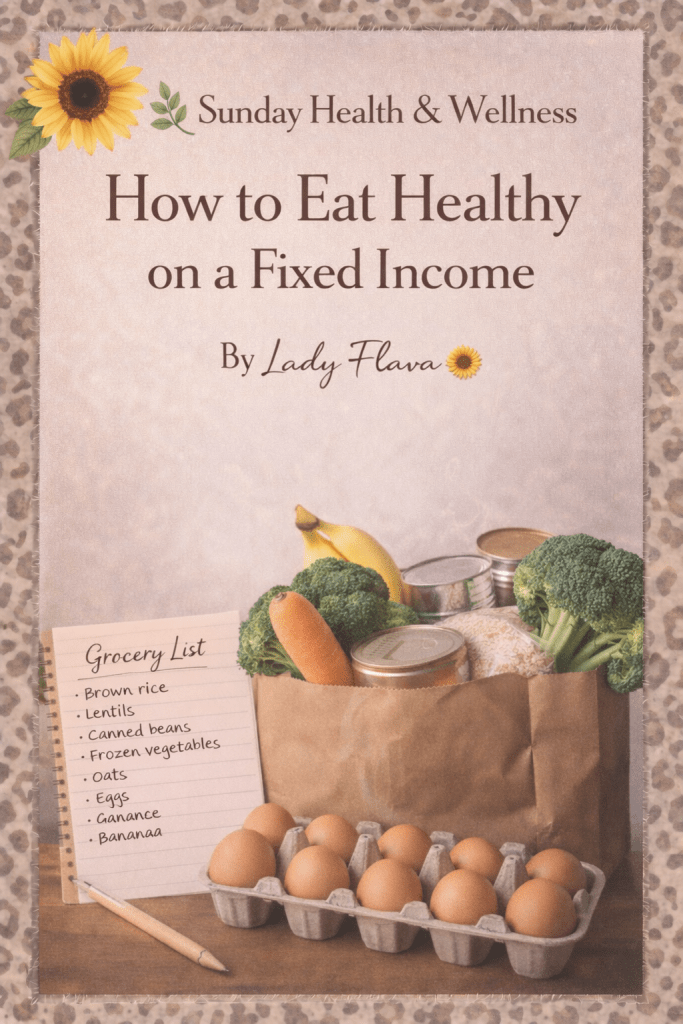
How to Eat Healthy on a Fixed Income
Let’s be honest.
Eating healthy can feel expensive.
Fresh produce. Lean meats. “Organic” labels everywhere.
It adds up fast.
But here’s the truth:
Healthy eating isn’t about fancy food.
It’s about smart choices and steady habits.
And you can absolutely nourish your body on a fixed income.
1. Plan Before You Shop
If you walk into the store without a plan, your money will disappear.
Write down 4–5 simple meals for the week.
Check what you already have.
Make a list — and stick to it.
Planning prevents waste. Waste costs money.
2. Build Meals Around Affordable Staples
You don’t need expensive ingredients.
Start with foods that stretch:
Brown rice Oats Whole-wheat pasta Beans (dry or canned) Lentils Eggs Potatoes Carrots Onions Bananas
These are inexpensive, filling, and nutrient-dense.
Beans and lentils especially?
High in protein, high in fiber, and extremely affordable.
3. Frozen Is Your Friend
Frozen vegetables are not “less than.”
They’re picked at peak ripeness.
They last longer.
And they’re often cheaper than fresh.
No guilt. No waste. Just convenience.
4. Choose Store Brands
Store brand oats, canned goods, rice, pasta —
same nutrition, lower price.
You’re paying for food, not packaging.
5. Cook at Home More Often
Pre-packaged meals and snacks cost more
and usually come with extra sodium and sugar.
Simple home meals go further.
Leftover rice becomes stir fry.
Extra beans become soup.
Cook once — eat twice.
That’s strategy stacking for your budget.
6. Don’t Shop Hungry
This one sounds small — but it matters.
Shopping hungry leads to impulse buys.
Impulse buys drain the budget.
Eat before you go.
7. Use Community Resources if Needed
There is no shame in support.
Food banks. Community programs. Senior meal services.
Feeding yourself and your family is strength — not failure.
Healthy Doesn’t Mean Perfect
You don’t need:
Organic everything Exotic superfoods Expensive protein powders
You need consistency.
Balanced meals.
Whole foods when possible.
Water instead of sugary drinks.
That’s it.
Final Thought
When money is tight, stress rises.
And stress affects health too.
So approach your meals with wisdom, not pressure.
Nourishment isn’t about impressing anyone.
It’s about sustaining your body with what you have —
in a way that honors both your health and your budget.
You deserve to eat well.
Even on a fixed income.
— Lady Flava 🌻