Prepare Your Home While You Still Can
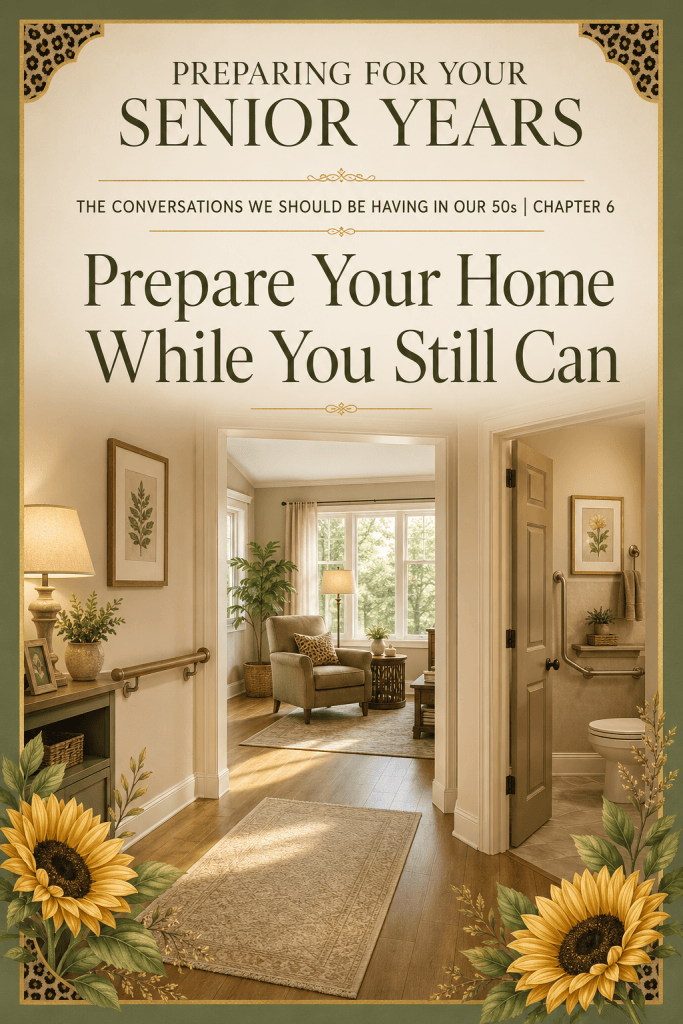
Preparing for Your Senior Years
The Conversations We Should Be Having in Our 50s | Chapter 6
Prepare Your Home While You Still Can
Dear Friends,
Most of us prepare our homes for the lives we are living today.
We choose furniture because we like how it looks. We place things where they fit. We climb stairs without thinking about them. We step into the bathtub, reach into high cabinets, carry laundry from one floor to another, and walk through dim hallways without imagining that any of it could become difficult.
Then life changes.
An injury happens.
Arthritis settles into our joints.
Our balance becomes less reliable.
We begin using a cane or walker.
Suddenly, the home we once moved through without a second thought starts telling us where we can and cannot go.
I understand this personally.
I live in a townhouse, and my peaceful top-floor space is what I lovingly call the Tower. It is where I work, write, watch the sky, and visit with my crows and squirrels.
But stairs that were once simply part of my home have become something I must seriously consider because of my hip and spine challenges.
I never imagined that mobility would affect how freely I moved through my own home. Yet here I am, at 66, learning that a beautiful home is not necessarily a home prepared for aging.
That is why we need to have this conversation in our 50s—while we still have the strength, time, resources, and ability to make thoughtful choices.
Look at Your Home Through Older Eyes
Walk through your home and stop looking at it only as the person you are today.
Look at it as someone who may one day have arthritis, reduced vision, balance challenges, weakness, chronic pain, or limited mobility.
Ask yourself:
- Could I safely enter my home using a walker?
- Is there a bathroom I could reach without climbing stairs?
- Could I live primarily on one floor if necessary?
- Are my hallways and walking paths wide and free of clutter?
- Could I get in and out of my shower safely?
- Would I be able to prepare food while sitting down?
- Is there enough lighting at night?
- Could emergency responders reach me easily?
- Would this home still work if I could no longer drive?
These are not negative questions.
They are responsible questions.
Start With Fall Prevention
A loose rug may not seem dangerous until your foot catches on it.
An extension cord across the floor may not bother you until you are using a walker.
A dark hallway may feel familiar until your vision changes or you wake during the night feeling unsteady.
Look for simple hazards:
- Loose rugs without nonslip backing
- Electrical cords in walking paths
- Clutter near doorways and hallways
- Poor lighting around stairs
- Uneven flooring
- Furniture that blocks clear movement
- Pets, pet toys, or food bowls underfoot
- Frequently used items stored too high or too low
Preparing does not require turning your home into a medical facility. It means making thoughtful changes before a fall forces the conversation.
Pay Special Attention to the Bathroom
The bathroom can become one of the most challenging rooms when mobility changes.
Wet floors, low toilets, narrow spaces, and tubs that require stepping over a high edge can create real problems.
Consider:
- Professionally installed grab bars
- A shower chair or bench
- A handheld showerhead
- Nonslip flooring or a secure bath mat
- A raised toilet seat if needed
- Clear access for a cane or walker
- Toiletries stored within easy reach
- Good lighting for nighttime bathroom trips
Do not wait until after a fall to decide that a grab bar would have been helpful.
And please understand the difference between a grab bar and a towel rack. A towel rack is not designed to support your body weight.
Think About Your Stairs
If your home has stairs, ask yourself what would happen if you temporarily—or permanently—could not use them.
Where would you sleep?
Where would you bathe?
How would you reach the kitchen?
Could you safely manage laundry?
Would a secure second handrail help?
Could part of the main floor eventually become a sleeping area?
Would you consider a stairlift, ramp, or different living arrangement if your mobility changed?
You do not have to make every change today. But you should understand your options before you are making decisions in pain, after surgery, or during a crisis.
Make Everyday Items Easier to Reach
We often organize our homes around appearance instead of accessibility.
Move the things you use regularly to comfortable reaching height. Avoid storing heavy cookware above your shoulders or necessities near the floor.
Create a seated workspace in the kitchen if standing becomes tiring. Keep medications, important documents, emergency numbers, and medical information in places that are organized and easy to access.
Small adjustments can preserve energy and reduce unnecessary bending, reaching, and lifting.
Renters Need a Plan Too
You do not have to own your home to prepare it.
Renters can still:
- Use removable nonslip products
- Improve lighting
- Rearrange furniture
- Create wider walking paths
- Use a shower chair
- Ask management about approved safety modifications
- Learn which accommodations may require written permission
- Keep a record of all requests and approvals
Your home does not have to belong to you for your safety to matter.
Technology Can Support Independence
Simple technology can make aging at home safer and easier.
Consider:
- Motion-activated night-lights
- A video doorbell
- Smart speakers for hands-free calls
- Medication reminders
- Emergency alert devices
- Automatic lighting
- A phone charging station near your bed
- A list of trusted contacts that is easy to locate
Technology should not replace human support, but it can provide another layer of protection.
Decluttering Is Part of Preparing
Preparing your home is not only about equipment.
It is also about deciding what you truly need.
Too many belongings can make it difficult to move safely, clean the home, find important items, or bring in caregiving equipment later.
You do not have to empty your entire house in one weekend.
Start with one drawer.
One closet.
One walkway.
One room.
Let go of what no longer serves you while you still have the energy and authority to make those decisions yourself.
Your Home Should Support Your Life
Many of us dream of aging in place.
But aging in place requires more than wanting to remain in the same home. The home must be able to support the body, health, finances, and assistance we may need later.
Sometimes preparing means modifying the home we love.
Sometimes it means moving to a home with fewer stairs.
Sometimes it means living closer to family, transportation, medical care, or community resources.
There is no shame in changing your environment so that you can remain as safe and independent as possible.
The goal is not to prove that you can struggle through a home that no longer works for you.
The goal is to create a home that works with you.
Conversation Starter
Take an honest walk through your home—or ask someone you trust to walk through it with you.
Choose three questions to discuss:
- What part of my home would become the biggest challenge if my mobility changed?
- What safety improvement can I make now?
- Could I live on one floor if necessary?
- What would need to change for me to use a walker safely?
- Who would help me make decisions after an injury or surgery?
- Do I want to remain in this home as I age, and is that choice realistic?
Do not wait until you are overwhelmed, hurting, or being discharged from the hospital to begin thinking about these things.
Prepare while you still have choices.
Prepare while you still have time.
Prepare while the decisions can be made calmly and intentionally.
Because growing older is a privilege.
Preparing for it is a choice.
Your future self will thank you.
Blessings from Flava in Her Tower 🌻
Lady Flava Wellness 🌻