

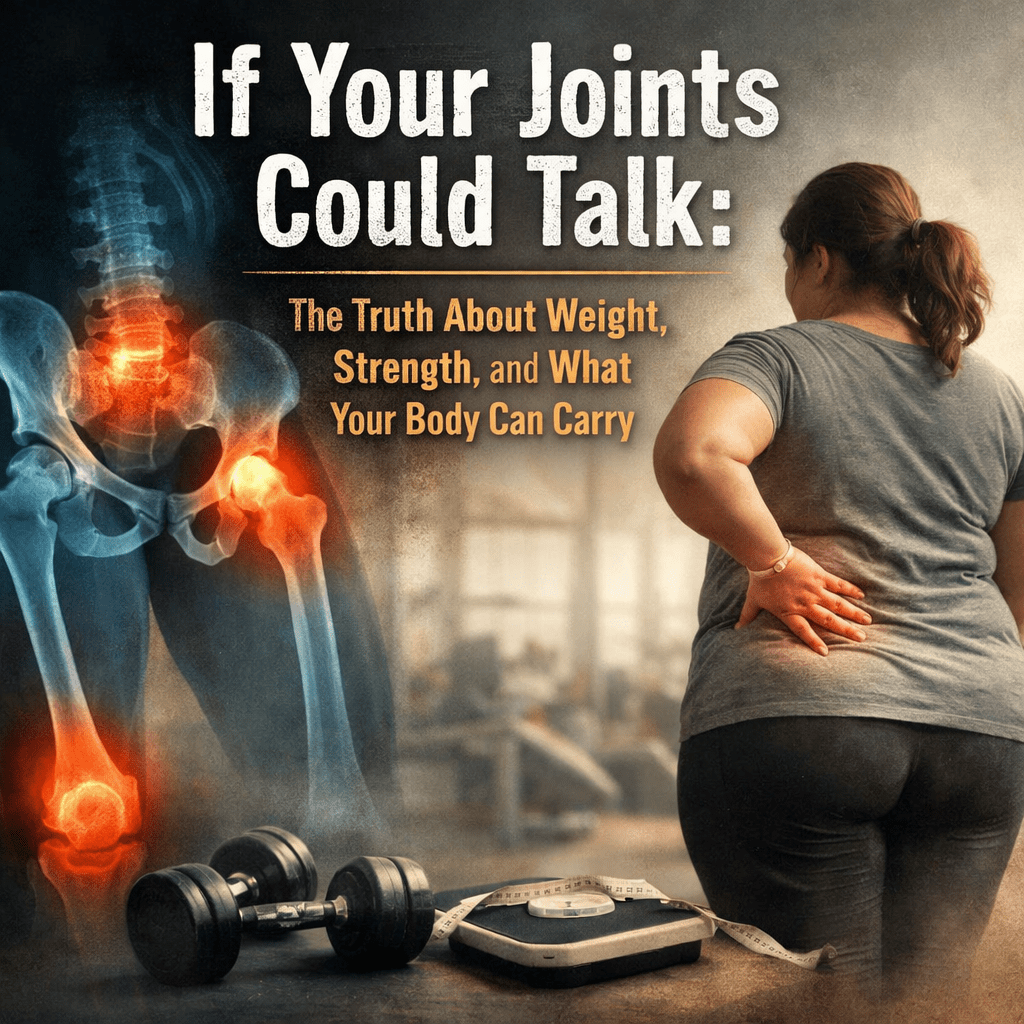
If Your Joints Could Talk: The Truth About Weight, Strength, and What Your Body Can Carry
Early in the year, many of us think about weight.
But maybe the better question isn’t:
“How much do I want to lose?”
Maybe it’s:
What is my body structurally designed to carry?
Our skeleton is a framework.
Bones don’t endlessly adjust to increasing load.
Joints are mechanical hinges.
Muscle is the support system that protects them.
When we consistently carry more weight than our frame comfortably supports, the body compensates quietly.
Knees compress.
Hips shift.
Lower back tightens.
Blood pressure rises.
Energy dips.
Sometimes we don’t feel it until years later.
I learned this the long way.
Before my knee replacements, I was told to reduce weight — not for appearance, but for surgical safety and long-term function. Surgeons understand load. Every extra pound increases pressure across the knees. After surgery, muscle becomes even more important. Artificial joints still rely on strength and stability around them.
When I moved to Las Vegas, my surgeons encouraged water therapy. I had access to pools where I lived. In the water, my joints were supported. I could move without pounding my knees. I became stronger. My body slimmed down naturally because I could move consistently.
Environment matters.
Access matters.
Consistency matters.
But here’s the part we don’t talk about enough:
Losing weight isn’t enough.
If we lose weight without preserving muscle, we can feel weaker. Weak hips feel unstable. Weak glutes make it hard to stand tall. And unstable joints don’t inspire confidence.
Recently, I overdid resistance bands while sitting at my desk. I thought I was being productive — strengthening while working. Instead, I fatigued my hip stabilizers. When I stood up, I felt stiff and unstable. That was a lesson.
Strength requires balance.
Rest requires respect.
Structure requires support.
Healthy weight isn’t about looking smaller.
It’s about load.
It’s about:
• What your knees can handle
• What your hips can stabilize
• What your heart can pump comfortably
• What your blood pressure can sustain
• What your energy can carry through a workday
Our skeleton is not meant to carry unlimited weight forever.
But it is incredibly adaptable when supported correctly.
As we age, muscle becomes even more critical.
Protein becomes essential.
Gentle strength work becomes necessary.
Sitting more than we move shows up in our hips and back.
Ignoring blood pressure shows up in our heart.
So maybe this year the question isn’t:
“How small can I get?”
Maybe it’s:
Is my body structurally supported for the life I want to live?
Am I:
• Preserving muscle while I lose weight?
• Eating enough protein to protect my joints?
• Moving consistently but realistically?
• Choosing long-term function over short-term numbers?
A Thoughtful Place to Begin
Not extreme. Not dramatic.
Just intentional.
Maybe that looks like:
• Adding one solid protein source to your day — Greek yogurt, eggs, cottage cheese, chicken, even peanut butter with whole grain crackers.
• Standing a little more than you sit.
• Doing a few sit-to-stands from your chair.
• Walking for a few minutes after meals.
• Using water therapy if accessible.
• Choosing consistency over intensity.
Nothing heroic.
Just supportive.
Because healthy weight isn’t about shrinking.
It’s about giving your structure what it needs to function well — today and years from now.
If your joints could talk, they probably wouldn’t ask you to be smaller.
They would ask you to be stronger.
 Lady Flava News