Sunday Health & Wellness
Your Bladder, Bowels & Pelvic Floor Are All Connected
When One Is Struggling, The Others May Feel It Too
Disclaimer: I am not a doctor or medical professional. I share information from my own health and wellness journey, my years working around healthcare, and information I research from reputable medical sources. Always speak with your healthcare provider about symptoms or changes that concern you.
One thing I have learned while dealing with my own bladder issues is that sometimes we are looking at one body part when we need to look at the whole neighborhood.
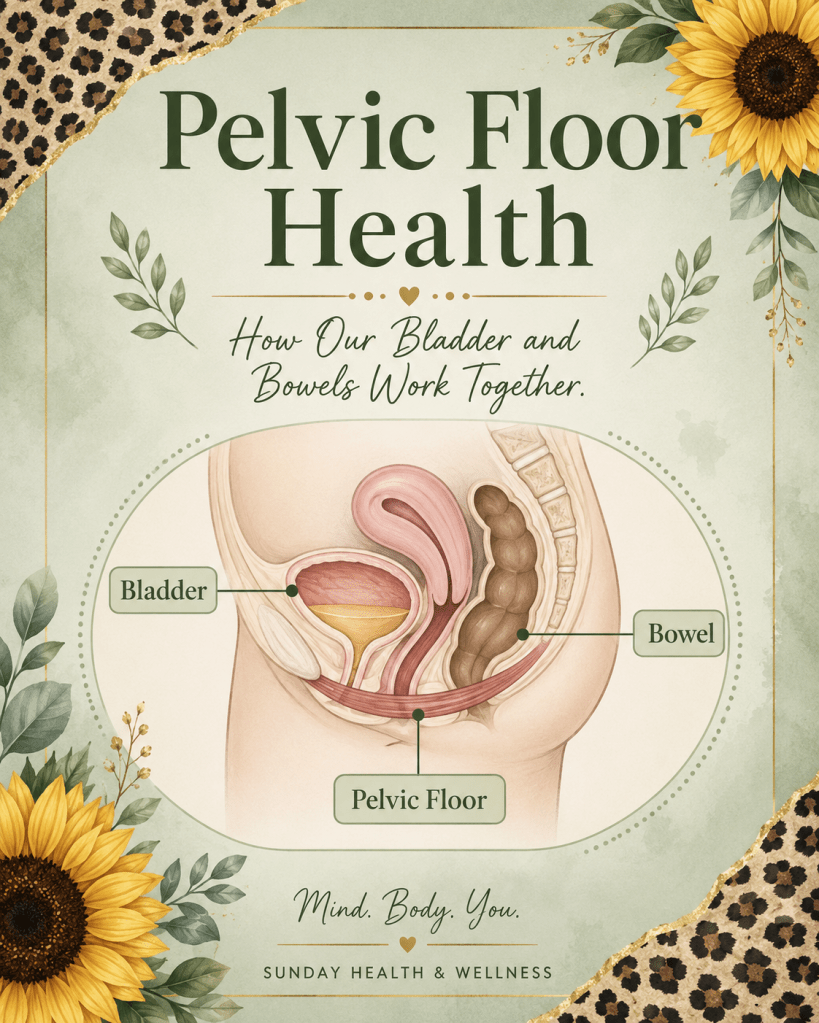
The bladder is over here.
The bowels are over there.
And somewhere underneath all of it is the pelvic floor.
Except…they really aren’t operating independently.
They are connected.
And I don’t think we talk about that enough.
So, What Exactly Is The Pelvic Floor?
The pelvic floor is a group of muscles and connective tissues at the bottom of our pelvis. Think of it almost like a hammock supporting the organs sitting above it.
Those muscles help support and control our bladder and rectum, and in women, they also support the uterus. They help us hold and release urine, stool and gas at the appropriate time. (NIDDK)
That means our pelvic floor has more than one job.
It has to know when to tighten.
It also has to know when to relax.
And everything has to coordinate.
That last word has become very important to me:
Coordinate.
Because pelvic floor health isn’t necessarily just about having muscles that are “too weak.”
Sometimes the problem can involve muscles that aren’t relaxing properly or aren’t coordinating correctly with the abdominal muscles when we’re trying to empty our bowels. (Mayo Clinic)
That was eye-opening for me.
Now Let’s Talk About Our Bowels
There is a pretty wide range of what is considered a typical bowel schedule.
Some healthy people may have a bowel movement as often as three times a day, while others may go around three times a week. Your own normal pattern matters too. (Cleveland Clinic)
So going every single day is not necessarily the requirement that many of us grew up believing.
But frequency isn’t the only thing we should pay attention to.
Are you straining?
Is your stool extremely hard?
Do you feel like you didn’t completely empty?
Are you sitting there forever trying to make something happen?
Those things matter.
Constipation isn’t only about how many days have passed. Difficulty passing stool, hard stools, straining and incomplete emptying can also be signs of constipation. (Mayo Clinic)
And here’s where our bladder comes walking back into the conversation.
Constipation Can Affect Your Bladder
Yep.
The bowel and bladder are sitting in the same limited space inside the pelvis.
And chronic constipation can make urinary problems worse. The National Institute of Diabetes and Digestive and Kidney Diseases specifically recommends avoiding constipation as part of preventing urinary incontinence. (NIDDK)
Mayo Clinic also notes that constipation can worsen urinary incontinence. (Mayo Clinic)
Think about it.
If your rectum is full of stool and you’re repeatedly straining to have a bowel movement, there can be increased pressure within the pelvic area.
And over time, straining isn’t doing that pelvic floor any favors either.
So somebody may be concentrating entirely on their bladder leakage while their bowel habits are contributing to the same pelvic floor system they’re trying to improve.
That is why we have to look at the whole picture.
And The Connection Goes Both Ways
Pelvic floor dysfunction can also contribute to bowel problems.
NIDDK lists pelvic floor disorders as one possible cause of delayed emptying of the colon. (NIDDK)
Pelvic floor dysfunction can show up as:
Urinary leakage.
Urinary urgency or frequency.
Difficulty completely emptying your bladder.
Constipation.
Difficulty getting stool out.
Bowel leakage.
Pelvic discomfort.
Sometimes lower back or hip discomfort may also be part of the larger pelvic picture. (Mayo Clinic)
That is a whole lot more than:
“Do your Kegels.”
And that is something I wish more of us understood.
Pelvic Floor Health Is Not Always About Squeezing Harder
For years, many of us have heard:
“Do Kegels.”
Leak urine?
Kegels.
Had a baby?
Kegels.
Getting older?
Kegels.
But the pelvic floor has to do more than contract.
It has to release too.
If your muscles are not coordinating and relaxing correctly when you’re trying to have a bowel movement, simply tightening them more may not address the actual problem.
That is why specialized pelvic floor physical therapy can involve much more than strengthening. Depending on the problem, therapy may include muscle coordination, relaxation, breathing, positioning, bowel or bladder training and sometimes biofeedback.
Treatment should be based on what your pelvic floor is actually doing.
Not assumptions.
Then There Is Incontinence
Incontinence simply means an involuntary loss of bladder or bowel control.
Urinary incontinence can happen in different ways.
Some people leak when coughing, sneezing, laughing or lifting.
Some experience that sudden:
I HAVE TO GO RIGHT NOW.
And sometimes that bathroom is ten feet away and might as well be ten miles. 😂
Others may have difficulty completely emptying their bladder or experience a combination of symptoms.
And bowel incontinence can happen too.
Interestingly, severe constipation itself can sometimes contribute to bowel leakage. Hard stool can collect in the rectum while looser stool leaks around it. (NIDDK)
Once again…
The bowels, bladder and pelvic floor are having one big conversation whether we’re paying attention or not.
What Can We Do?
First, learn your own body.
What is normal for you?
Pay attention to changes rather than comparing yourself to somebody else’s bathroom schedule.
Drink adequate fluids unless your healthcare provider has restricted them.
Eat enough fiber for your individual needs.
Move your body as much as you’re safely able.
Try not to repeatedly strain when having a bowel movement.
Pay attention to toilet positioning and give your body time to relax.
And if you’re having ongoing urinary leakage, bowel leakage, constipation, difficulty emptying, pelvic pain or major changes in bathroom habits, bring it up with your healthcare provider.
There are professionals who specifically evaluate bladder, bowel and pelvic floor function.
And yes…
Tell them about both ends. 😂
Don’t go to an appointment for bladder problems and forget to mention that you haven’t been pooping normally.
Don’t go in for chronic constipation and leave out the fact that you’ve also started leaking urine.
Those details may be connected.
And Please Pay Attention To Changes
Blood in your stool, black or tarry stools, severe abdominal or pelvic pain, inability to urinate, or a significant unexplained change in your bowel or bladder habits deserves medical attention rather than simply assuming it’s aging or pelvic floor weakness. (NIDDK)
Getting older certainly changes our bodies.
But everything that happens to us as we age shouldn’t automatically be dismissed as:
“Well, you’re getting older.”
Sometimes our body is giving us information.
We just have to learn how to listen.
Lady Flava’s Closing Thought 🌻
My health journey continues to teach me that the human body doesn’t operate in separate little boxes.
My hips don’t exist without my pelvis.
My pelvis doesn’t exist without my pelvic floor.
My pelvic floor doesn’t forget about my bladder.
And apparently my bowels have decided they are part of the committee too. 😂
So instead of asking:
“What is wrong with my bladder?”
Maybe sometimes the better question is:
“What is happening throughout my pelvic system?”
Because our bladder, bowels, muscles, nerves, breathing, movement and pelvic floor may all be communicating with each other.
And when we begin understanding those connections, we may finally start asking better questions about our health.
Know your body. Pay attention to your normal. Notice the changes. And never be embarrassed to talk about pee or poop.
Trust me.
Healthcare professionals have heard it all.
🌻 Lady Flava Wellness 🌻