Wednesday Health & Wellness
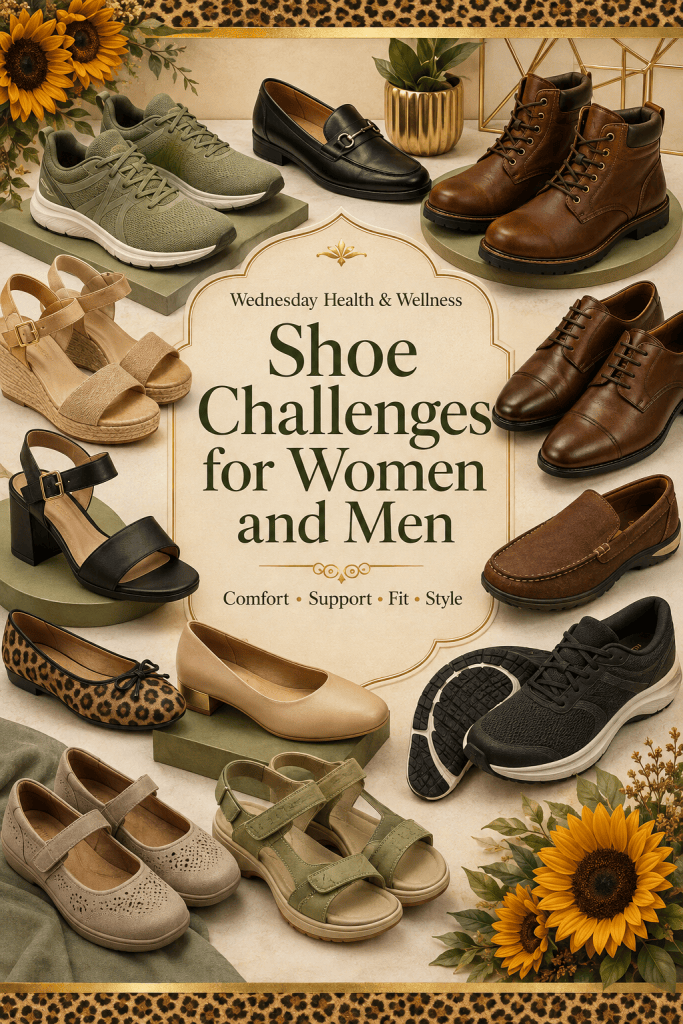
Shoe Challenges for Women and Men
Disclaimer: This blog shares general information and my personal experience. Persistent foot pain, numbness, swelling, wounds, or difficulty walking should be discussed with a healthcare professional or podiatrist—especially if you have diabetes or circulation problems.
Let’s talk about shoe health and wellness.
Years ago, my oldest daughter worked for a chiropractor. He frequently talked about how women were damaging their bodies by wearing high heels.
He explained that our bodies were not designed to spend hours pitched forward in high heels. The position places more pressure on the front of the feet and may affect how we stand, balance, and walk. Over time, poorly fitting shoes may contribute to pain in our feet and other parts of the body.
I remember listening, but I was still wearing my shoes. 🤣
When I lived in Las Vegas, I had a variety of shoes. I loved having different styles to complete an outfit. Even then, however, I had started making practical adjustments.
I chose low pumps instead of very high heels.
I wore wedges or wider heels instead of narrow heels.
I looked for shoes that gave me more stability while still allowing me to feel dressed up.
As I have gotten older, I have continued adjusting my shoe choices for comfort and safety. Some of the beautiful shoes I could wear in Vegas are no longer practical for the body I have today.
That does not mean I suddenly stopped appreciating beautiful shoes.
It means my feet, joints, balance, and mobility now have more voting power. 👠
High Heels and Women’s Feet
High heels shift more body weight toward the ball of the foot. Narrow or pointed shoes also crowd the toes and may increase pressure, rubbing, and discomfort.
This may contribute to problems such as:
- Pain in the ball of the foot
- Blisters, corns, and calluses
- Bunions becoming more painful
- Crowded or irritated toes
- Difficulty maintaining balance
- Changes in how we stand and walk
According to the Mayo Clinic, high heels force the toes toward the front of the shoe, while tight, narrow, or pointed shoes are associated with a greater likelihood of bunions. However, shoes are not the only factor. Foot structure, heredity, arthritis, stress, and injuries may also play a role. (Mayo Clinic)
In other words, we cannot blame every bunion on a high heel—but an unforgiving shoe can certainly make an already painful foot feel worse.
And let us not forget those unforgivable blisters.
A shoe can look beautiful in the mirror and become a weapon against your feet thirty minutes later. 🤣
Women’s Shoes Are Not the Only Problem
Men also deal with uncomfortable and poorly designed footwear.
A stiff leather dress shoe may look professional but offer very little cushioning during a long workday. Some boots need time to soften and may rub the heel or ankle during the so-called break-in period.
Men may also experience:
- Rigid soles with limited flexibility
- Narrow toe boxes
- Heel or arch pain
- Heat, sweat, and odor from shoes that do not breathe
- Blisters caused by stiff material or poor fit
- Limited dress-shoe styles that include proper cushioning and support
A man may not be standing in a four-inch heel, but that does not mean his shoes are supporting his feet properly.
One Size Does Not Always Fit the Same
Shoe shopping can be frustrating for women and men because sizing is not consistent between brands.
You may wear one size in a sneaker, another in a dress shoe, and something completely different in a boot. Widths also vary. A person with a wide forefoot, narrow heel, high arch, flat foot, or one foot larger than the other may struggle to find a shoe that fits comfortably.
Then online shopping adds another layer of guessing.
The shoe may look perfect on the screen, but we cannot feel the material, test the support, or know where it will rub until it arrives.
What Should We Look for in a Shoe?
A healthier shoe does not have to be ugly. It should simply work with your foot instead of fighting against it.
Look for:
- Enough room to comfortably move your toes
- A secure heel that does not slip
- Cushioning appropriate for your activity
- A stable sole
- Support that feels right for your arch
- Soft material around areas prone to rubbing
- A heel height you can safely and gracefully walk in
- The correct length and width for your actual foot
The NHS recommends roomy shoes with a low heel and soft sole for people experiencing bunion pain. It also advises against tight, pointed shoes and high heels when they worsen symptoms. (NHS)
It may also help to shop later in the day, when feet are more likely to be slightly swollen, and try on both shoes. If you wear orthotics or inserts, bring them when testing new shoes. Ill-fitting shoes that slide or squeeze can create friction, pressure, corns, and calluses. (Mayo Clinic)
Our Shoes Need to Change With Us
The shoe that worked for us at 30 may not work at 50, 60, or 70.
Our feet may become wider. Arthritis may affect our toes or ankles. Our balance may change. Old injuries may return to remind us they are still there.
We may also need different shoes for different days.
Some days may allow for a low pump.
Other days may require a supportive sneaker.
And some beautiful shoes may need to remain in the closet as a memory of where they once carried us.
There is no shame in adjusting.
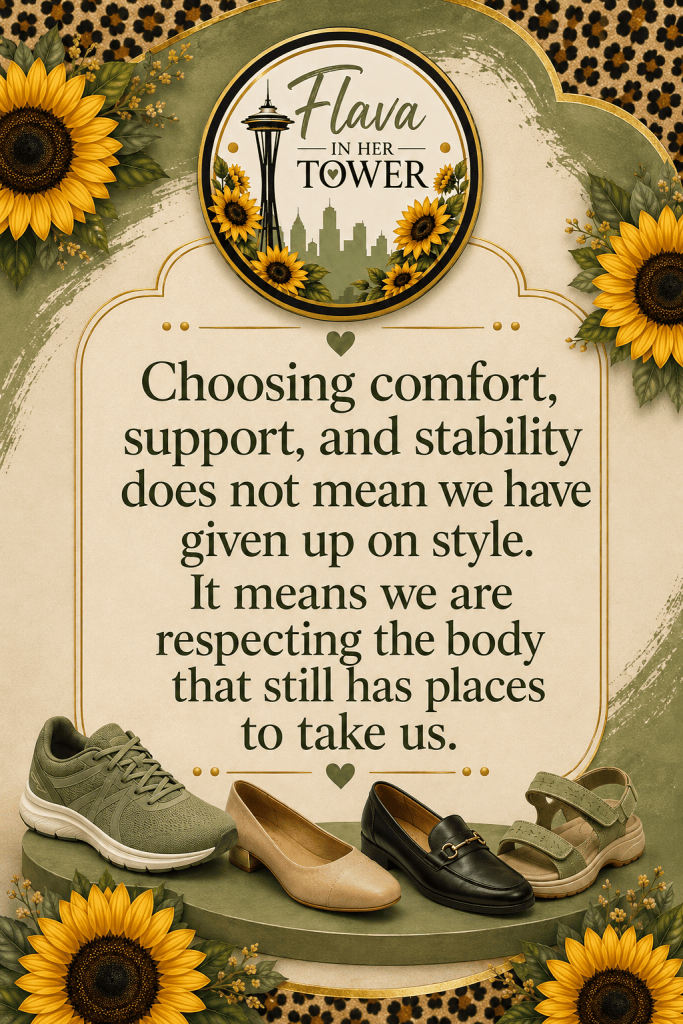
Choosing comfort, support, and stability does not mean we have given up on style. It means we are respecting the body that still has places to take us.
I was raised that you do not wear shoes you cannot walk gracefully in.
Today, I would add:
Do not wear shoes that make your body pay for the outfit long after you have taken them off.
Our feet carry us through our entire lives.
The least we can do is stop punishing them for fashion.
Lady Flava Wellness 🌻
Real Talk. Real Life. My Flava.