Friday Health & Wellness
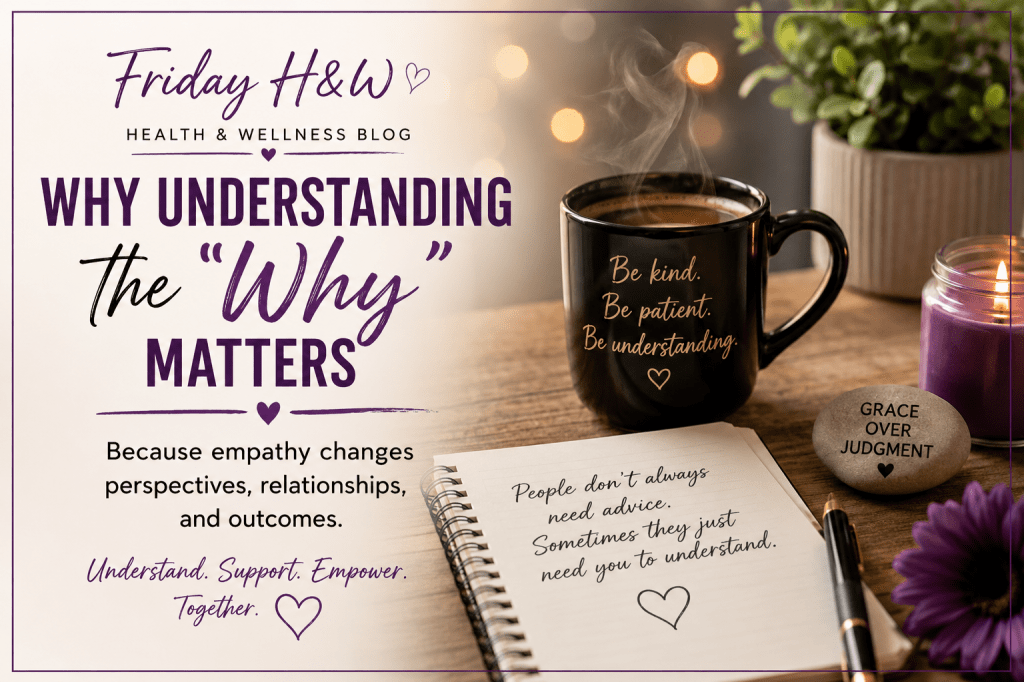
Why Understanding the “Why” Matters in Mental Health and Neurodivergence
I watched a video recently where two women were having an honest conversation about friendship and mental health.
One woman finally explained to her friend why she had been inconsistent at times. She shared that she was bipolar and openly explained how it can manifest in her life and relationships.
She was nervous to tell the truth.
You could tell she feared rejection.
She feared her friend walking away after finally understanding why certain behaviors had happened.
But instead, her friend stayed fully present.
She listened.
And then she responded with something powerful:
“I’m glad you told me. Now I understand what’s been going on.”
Then she simply said:
“Shall we go have lunch?”
That moment stayed with me.
Because sometimes understanding the “why” behind someone’s behavior changes everything.
Not to excuse harmful behavior.
Not to remove accountability.
But to bring context where there once was confusion.
I think this is why I feel so strongly about understanding neurodivergent people and mental health challenges.
So many people are walking through life carrying invisible struggles that others cannot see:
ADHD bipolar disorder autism anxiety PTSD depression sensory overload executive dysfunction
And when people do not understand these conditions, they often personalize behaviors instead:
“She’s lazy.” “He doesn’t care.” “They’re unreliable.” “They’re rude.” “They’re inconsistent.”
But sometimes behavior is communication.
Sometimes inconsistency is overwhelm.
Sometimes lateness is time blindness.
Sometimes withdrawal is emotional exhaustion.
Sometimes forgetfulness is executive dysfunction.
Sometimes irritability is a nervous system that has been overloaded too long.
I recently heard an HR professional discussing how ADHD can qualify as a disability in the workplace because it affects executive functioning skills like organization, focus, time management, and task completion.
That conversation made me think deeply.
Many neurodivergent people are not struggling because they lack intelligence or work ethic.
Sometimes their brains process information, stimulation, emotions, or transitions differently.
And honestly… disclosure can be scary.
At what point does someone tell an employer something personal like this without fearing judgment or discrimination?
That is a real concern for many people.
Some fear:
being treated differently being overlooked for leadership being labeled difficult having every mistake tied back to a diagnosis
That is why many people stay silent while quietly struggling.
But I also believe healthy environments matter.
The best workplaces and relationships are often the ones that ask:
“What tools help you succeed?”
instead of:
“What’s wrong with you?”
That is a completely different mindset.
Understanding people does not mean removing accountability.
It means recognizing that not everybody starts from the same neurological or emotional foundation.
Compassion and accountability can exist together.
And honestly, the world could use a little more of both.
Lady Flava 🌻