

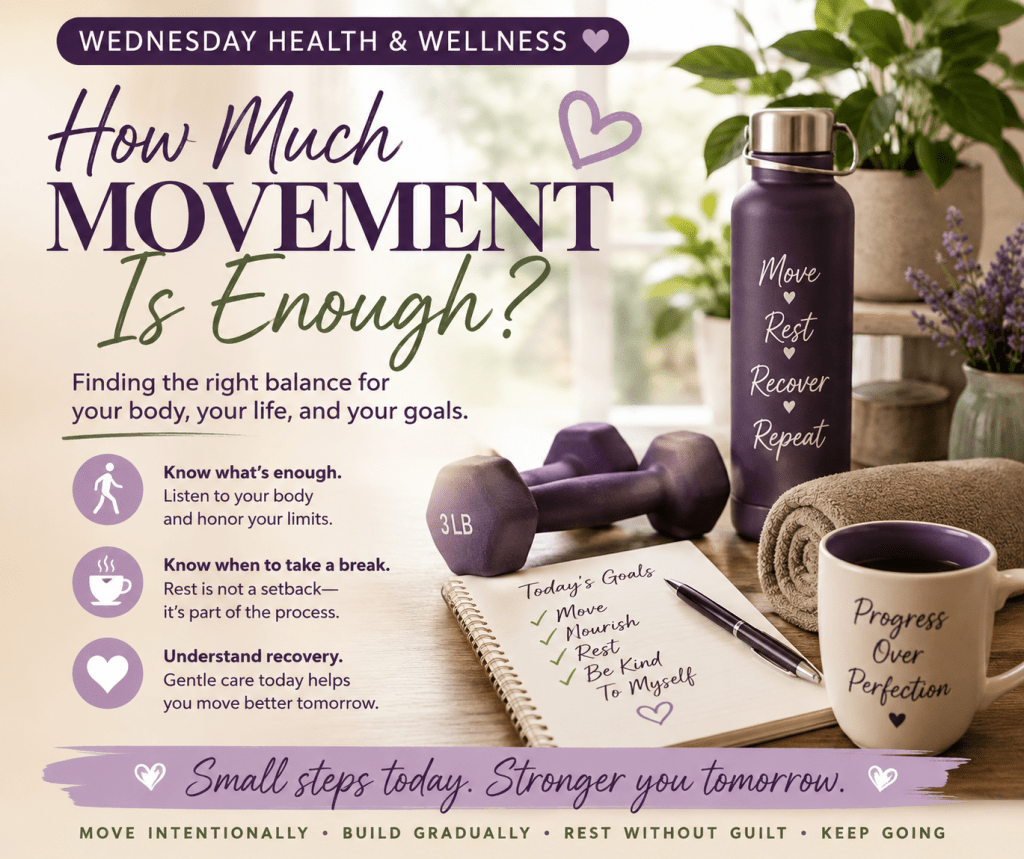
Wednesday Health & Wellness
How Much Movement Is Enough?
One of the things I have been thinking about lately is exercise as we get older.
Not exercise when you’re 25.
Not training for a marathon.
Not trying to get a six-pack.
I’m talking about intentional movement for seniors who simply want to remain strong, stable, mobile and independent.
Maybe you haven’t exercised in years.
Maybe you have arthritis.
Maybe you’re recovering from an illness or injury.
Maybe you live with a disability.
Maybe you use a cane or walker.
Maybe you move around just fine, but you’ve started noticing that you’re not as strong or steady as you used to be.
Or maybe one day you simply looked at yourself and thought:
I need to start moving my body more.
That’s wonderful.
But then comes a question I don’t think we talk about enough.
How much movement is enough?
And just as importantly:
How do we know when it’s time to take a break?
General recommendations for adults 65 and older include at least 150 minutes of moderate-intensity aerobic activity each week, muscle-strengthening activities at least two days a week, and activities that improve balance.
But I think it’s important to understand something.
Those are goals.
They don’t have to be your starting point.
Current guidance encourages older adults to start slowly and do what they can. Even small amounts of activity have benefits, and movement can be adapted for people living with disabilities or chronic health conditions.
I love that.
Because sometimes we hear 150 minutes a week and immediately think:
Well, I can’t do that.
Okay.
Can you do five minutes?
Can you stand up and sit down a few times?
Can you walk through your home?
Can you move your arms while sitting in a chair?
Can you use a resistance band?
Can you practice your balance while holding onto something sturdy?
Can you move your legs while lying in bed?
Start where your body is today.
Not where it was 20 years ago.
Not where somebody else’s body is.
Not where somebody on YouTube tells you it should be.
Where are YOU today?
Movement Doesn’t Have to Happen All at Once
This is something I’m learning for myself.
Yesterday, I did quite a bit of movement.
But I didn’t do one long workout.
I spread my movement throughout the day.
I would do something for a while, stop, rest and later do something else.
Today, I can feel a little soreness in my legs.
Nothing alarming.
Just my body reminding me:
Girl, we worked yesterday. 😂
So today I’m resting.
And here’s something else I noticed.
By 7:41 Monday evening, I wasn’t exhausted.
That means something to me.
I moved my body yesterday.
My muscles know they worked.
But I didn’t completely drain myself.
I’m beginning to understand that there is a difference between challenging my body and exhausting my body.
And I think that distinction becomes increasingly important as we get older.
How Do You Know When You’ve Done Enough?
I’m learning that the answer may not always come during the exercise.
Sometimes your body tells you later.
Maybe your muscles feel pleasantly worked.
Maybe you’re a little sore the next morning.
Maybe you feel stronger and energized.
Or maybe you realize you did too much because normal activities suddenly feel harder.
That’s information.
We have to learn to listen to our bodies without becoming afraid to challenge them.
During moderate-intensity activity, your breathing and heart rate will usually increase, but you should generally still be able to carry on a conversation.
But there are also things we shouldn’t simply push through.
Unusual shortness of breath, dizziness, chest pain or other concerning symptoms deserve attention rather than a “keep going no matter what” attitude. Federal healthy-aging guidance recommends talking with a healthcare professional about symptoms such as chest pain or shortness of breath.
There is no trophy for overdoing it.
Sometimes the healthiest decision you can make is:
That’s enough for today.
What Does Recovery Look Like?
I think we sometimes treat rest like we’ve done something wrong.
We haven’t.
Recovery is part of movement.
Recovery might mean sitting down and allowing your breathing to settle.
Drinking water.
Eating nourishing food.
Getting a good night’s sleep.
Doing gentle movement instead of strengthening exercises.
Giving muscles you worked yesterday some time to recover.
Or simply paying attention to how your body feels today before deciding what you’re going to ask of it.
Recovery doesn’t always mean doing absolutely nothing.
Sometimes it means having a lighter day.
And sometimes?
You may decide to rest.
That’s what I’m doing today.
Yesterday was a movement day.
Today is a recovery day.
Tomorrow?
I’ll reassess.
That’s something I want to get better at—not automatically deciding what tomorrow’s body should be able to do based on what yesterday’s body accomplished.
Don’t Forget Why You’re Moving
For seniors, exercise isn’t only about losing weight or changing how our bodies look.
Strength helps us get out of chairs.
Balance helps reduce our risk of falling.
Mobility helps us move through our homes and communities.
Endurance helps us continue doing the things we enjoy.
Regular physical activity can help older adults maintain physical function and independence.
That’s why I want to change the question.
Instead of always asking:
How hard did I work today?
Maybe we should ask:
Did I do something today that helps me continue doing things for myself tomorrow?
That might be five minutes today.
Maybe eventually it becomes ten.
Maybe one day it’s walking around the block.
Maybe it’s dancing.
Gardening.
Swimming.
Going to an exercise class.
Or simply moving around your home more confidently than you did before.
Your starting point doesn’t determine your finish.
But you do have to respect your starting point.
Move intentionally.
Build gradually.
Take breaks.
Pay attention.
Recover without guilt.
And keep going.
Because at this stage of life, I don’t believe movement should be punishment for what our bodies look like.
Movement is an investment in what we want our bodies to continue being able to do.
And sometimes that investment includes knowing when to move…
and knowing when to rest.
Blessings from Flava in Her Tower
Lady Flava Wellness 🌻
 Lady Flava News