

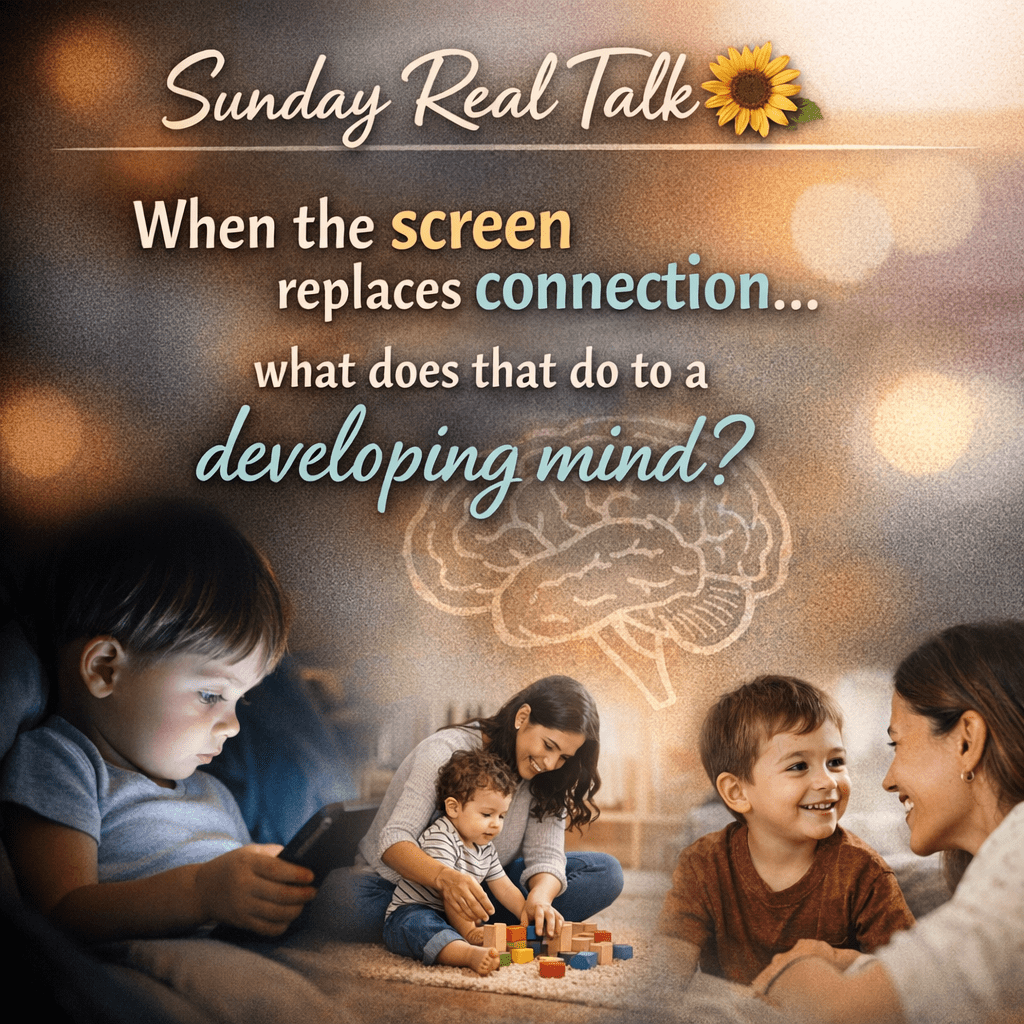
Sunday Real Talk 🌻
“Virtual Autism” — What Are We Really Seeing?
I hadn’t even heard of this term either… until recently.
And when I looked into it, I paused.
Because this isn’t something to throw labels around lightly.
“Virtual autism” is not an official diagnosis.
It’s not in the DSM.
It’s not the same as Autism Spectrum Disorder.
What people are really talking about is this:
Young children—especially babies and toddlers—
spending a lot of time in front of screens
instead of being in real, human interaction.
And over time…
some of them start showing behaviors that look concerning:
Less eye contact Delayed speech Less engagement with people More withdrawal Short attention spans Big reactions when screens are taken away
Now here’s the part that matters—
That doesn’t automatically mean autism.
It can mean a child’s brain isn’t getting
what it needs most at that age:
Faces
Voices
Touch
Movement
Back-and-forth interaction
Real life.
Let’s be honest for a second…
Screens are everywhere now.
They help tired parents.
They keep kids occupied.
They’ve become part of how we function.
So this isn’t about blaming.
But it is about awareness.
Because a developing brain
can’t learn connection from a screen the same way
it learns from a person sitting right in front of them.
Here’s where it gets hopeful
What makes this conversation different…
is that many of these behaviors
can improve when the environment changes.
When there’s:
More talking
More eye contact
More play
More outside time
More “back and forth” moments
You start to see shifts.
That tells you something important—
this isn’t about labeling a child…
…it’s about what they’ve been exposed to.
Real Talk Ending
We live in a digital world.
That’s not going away.
But our children?
They still need a human world first.
Not perfect parenting.
Not guilt.
Just more presence.
More connection.
More real-life moments that no screen can replace.
Because sometimes…
it’s not about what’s “wrong” with the child.
It’s about what’s been missing.
Lady Flava
 Lady Flava News