Monday Health & Wellness
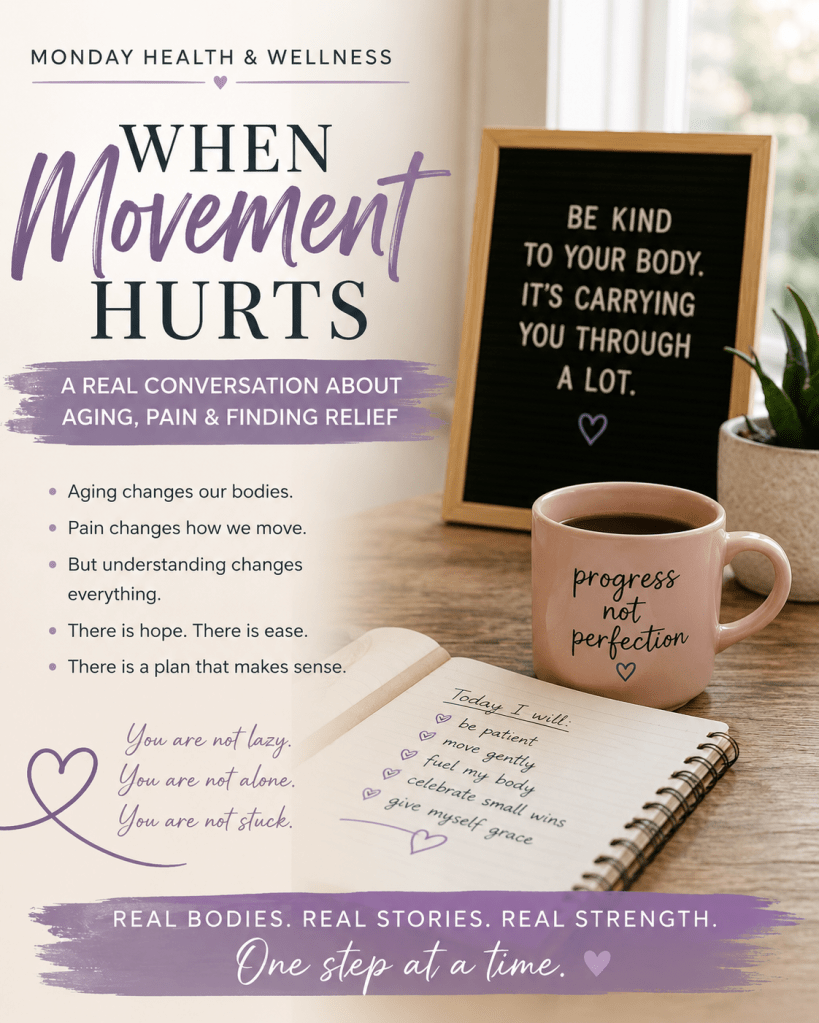
When Movement Hurts
There is a conversation that many people living with chronic pain quietly understand… but the outside world often does not.
As we age, our bodies change.
Joints wear down.
Muscles weaken.
Inflammation increases.
Recovery slows.
And for some people, movement itself begins to feel uncomfortable, exhausting, or even painful.
One of the first things healthcare professionals often say is:
“Watch what you eat and move more.”
And honestly… they are not wrong.
Overall health matters.
Weight matters.
Mobility before surgery matters.
Muscle strength matters.
The success of procedures and recovery can absolutely be affected by how well a body is functioning beforehand.
I understand that now more than ever.
But I also think there is another side to this conversation that deserves more compassion and honesty.
What happens when movement hurts?
What happens when simply standing up, turning in bed, getting off the toilet, walking through a grocery store, or sitting too long causes discomfort?
People who live with chronic pain often begin adapting quietly without even realizing it.
We conserve movement.
Not because we are lazy.
Not because we don’t care about our health.
Not because we want to gain weight.
But because our bodies begin teaching us that certain movements come with consequences.
So we move less.
We sit more carefully.
We avoid stairs.
We shorten our walking distances.
We brace ourselves before standing.
We learn how to get through the day with the least amount of discomfort possible.
Then over time another cycle begins.
Less movement leads to:
loss of stamina muscle weakness stiffness weight gain more pressure on joints and the spine even more difficulty moving
It becomes a cycle many people feel trapped inside of.
Recently, I went into physical therapy hopeful.
I wanted relief.
I wanted strength.
I wanted movement.
Instead, I ended up needing a walker and learning that my spine is also affected by arthritis and degeneration in addition to my hips.
That realization changed the conversation for me.
Suddenly my mind was asking:
If the hips hurt…
and the spine is involved…
and movement causes flare ups…
then what kind of exercise actually makes sense?
That is not me rejecting movement.
That is me trying to understand how people realistically move forward while living in painful bodies.
I think many patients are not looking for judgment.
They are looking for guidance that feels realistic.
Maybe instead of only hearing:
“Lose weight and move more.”
Patients also need to hear:
“I know movement is hard right now. Let’s figure out what your body can tolerate safely and gradually build from there.”
That matters emotionally.
Because many people living with chronic pain already know they need to move.
They know their bodies would benefit from strengthening, weight loss, and conditioning.
The real question is:
How do we begin when movement already hurts?
Maybe the answer is not extreme exercise.
Maybe it begins with:
pool therapy short walks chair exercises stretching gentle strengthening consistent nutrition small realistic goals rebuilding trust with movement slowly
I do not have all the answers.
I am learning in real time.
But there is one thing I now understand clearly:
sometimes pain is not simply about “getting older.”
Sometimes it is the body trying to tell a deeper story.
And sometimes what feels like a setback is actually the moment we finally begin discovering the full picture of what our bodies have been carrying all along.
— Lady Flava 🌻